As a neurologist for atypical Parkinsonism and PSP, I help patients who have frequent falls, stiff movements, or difficulty moving their eyes. If your loved one is showing signs of balance loss, changes in speech, or trouble looking down, this page will help you understand what PSP is and how we can manage it together with expert care.
Hello, I’m Dr. Mitesh Chandarana
I’m a neurologist and movement disorder specialist. One of the conditions I often diagnose in older adults is Progressive Supranuclear Palsy (PSP) a type of atypical Parkinsonism.
It looks like Parkinson’s disease in the beginning, but has some important differences. My goal is to catch it early, explain it clearly, and help you or your family manage the symptoms with care and dignity.
What Is PSP?
PSP is a progressive brain condition that affects:
-
- Movement
-
- Balance
-
- Eye control
-
- Speech and thinking
It happens when certain brain cells break down faster than normal, especially in areas that control balance and eye movement. PSP is not inherited in most cases and not caused by any infection.
It usually begins in people aged 60 and above and progresses slowly over time.
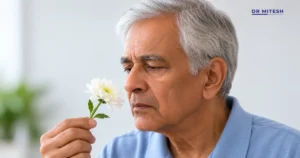
 Highlighting facial muscle rigidity and emotional flatness often seen in Progressive Supranuclear Palsy (PSP).
Common Symptoms I See in PSP
➤ Balance & Movement:
-
- Falling backwards suddenly without warning
-
- Trouble walking straight (staggering or stiff walking)
-
- Feeling feet are “stuck to the ground”
-
- Difficulty standing up from a chair
-
- Postural stiffness in the neck and back
➤ Eye Movement Issues:
-
- Difficulty looking downwards (most specific sign)
-
- Trouble reading or using stairs
-
- Blinking problems or eyes shutting suddenly
-
- Double vision
➤ Speech & Swallowing:
-
- Slurred or slow speech
-
- Soft voice
-
- Difficulty swallowing (especially in later stages)
➤ Mental & Behavioral:
-
- Reduced interest or motivation
-
- Mood changes, emotional outbursts
-
- Memory loss or confusion
-
- Difficulty making decisions
How I Diagnose PSP
There’s no single test that confirms PSP. I rely on:
-
- Detailed clinical examination
-
- Watching how a patient walks, talks, and moves eyes
-
- Ruling out Parkinson’s and other similar conditions
-
- MRI brain – may show shrinkage in midbrain (helpful in PSP diagnosis)
Many patients are misdiagnosed with Parkinson’s disease at first. As a specialist in atypical Parkinsonism, I look closely for signs that point toward PSP.
PSP vs. Parkinson’s: Key Differences
| Feature | Parkinson’s | PSP |
|---|---|---|
| Tremors | Common | Rare |
| Falls | Late in disease | Early and frequent |
| Eye problems | Rare | Common (especially downward gaze) |
| Response to medicines | Good | Poor or short-lived |
| Speech/swallowing issues | Late | Early |
How I Manage PSP
There is no cure for PSP, but we can manage many symptoms and improve quality of life.
1. Medicine Support
-
- Parkinson’s medicines like Levodopa may help in early stages
-
- Sometimes amantadine is added for movement or energy
-
- Medicines for mood, sleep, and emotional control may be needed
While the benefit from medicines may be limited, they help in specific symptoms.
2. Eye and Vision Care
-
- Glasses with prism lenses may help reading or seeing clearly
-
- I teach patients and families head movement techniques to assist vision
-
- Botox may help if eyes are closing forcefully (blepharospasm)
3. Physiotherapy & Fall Prevention
-
- Balance training to reduce falls
-
- Supportive walking devices (walker with brakes, wide-base cane)
-
- Home adjustments for safety (grab bars, anti-slip flooring)
Early therapy can keep patients independent for longer.
4. Speech & Swallowing Therapy
-
- Speech therapy for soft voice or slurred speech
-
- Swallowing therapy to avoid choking
-
- Diet changes to prevent aspiration
5. Family Counseling & Support
-
- PSP affects both patients and caregivers
-
- I provide emotional guidance, regular reviews, and long-term planning
-
- Help with disability certification and support options
My Focus: Comfort, Safety & Quality of Life
Even if we can’t stop PSP, we can slow the effects, reduce complications, and give patients and families tools to cope. My job is to be a steady partner throughout the journey.
Frequently Asked Questions (FAQs)
Q1. Is PSP the same as Parkinson’s?
No. PSP is a separate condition. It looks similar at first but has early falls, poor medicine response, and eye movement problems. Know More
Q2. Is there a cure for PSP?
Currently, no. But many symptoms can be managed well with a multi-specialist approach. Know More
Q3. Can medicine help?
In some cases, Parkinson’s drugs like levodopa may give temporary relief. But response is usually less than in Parkinson’s. Know More
Q4. Is PSP inherited?
Most cases are not inherited. It is considered a sporadic condition. Know More
Q5. What is the life expectancy?
Most patients live around 6-10 years after diagnosis. Care, therapy, and fall prevention can improve quality of life. Know More
Let’s Manage PSP Together — With Care & Clarity
If you or your family member is falling often, showing eye movement issues, or not improving on Parkinson’s medicines don’t delay. Early diagnosis helps us plan better.
Book Your Appointment Today
 Call: 8866843843
 Medisquare Superspeciality Hospital, Ahmedabad