As a doctor for Parkinson’s disease, I help patients manage tremors, stiffness, and slowness using correct diagnosis, personalized medicine plans, and advanced treatment like Deep Brain Stimulation (DBS). If you or your loved one is noticing symptoms, this page will help you understand when to seek help, what treatments are available, and how we can improve your quality of life together.
Hello, I’m Dr. Mitesh Chandarana
I’m a Parkinson’s specialist in Ahmedabad, trained in Movement Disorders. I see many patients every week who are struggling with symptoms like tremors, stiffness, and walking problems. My goal is simple, to help you live better with Parkinson’s disease using the right treatment, at the right time.
What Is Parkinson’s Disease?
Parkinson’s disease is a slow, long-term brain condition that affects your movement and body control. It happens because certain brain cells stop making a chemical called dopamine, which helps your body move smoothly.
This leads to problems like:
-
- Shaking (tremors)
-
- Stiffness
-
- Slow movements
-
- Balance issues
Parkinson’s is not the same for everyone. Some people have mild symptoms. Others need more help as the disease progresses. But with early diagnosis and good care, we can manage it well.
Who can develop Parkinson’s disease?
- It is common in people over 60 years of age, but can occur in younger people as well.
- The symptoms usually begin gradually and get worse over time.
- About 5 in 1,000 people in their 60s and about 40 in 1,000 people in their 80s have PD. It affects men and women but is a little more common in men.
- Cases under 40 years of age consist of 10-15% of all cases and are known as young onset Parkinson’s disease.
What happens in PD?
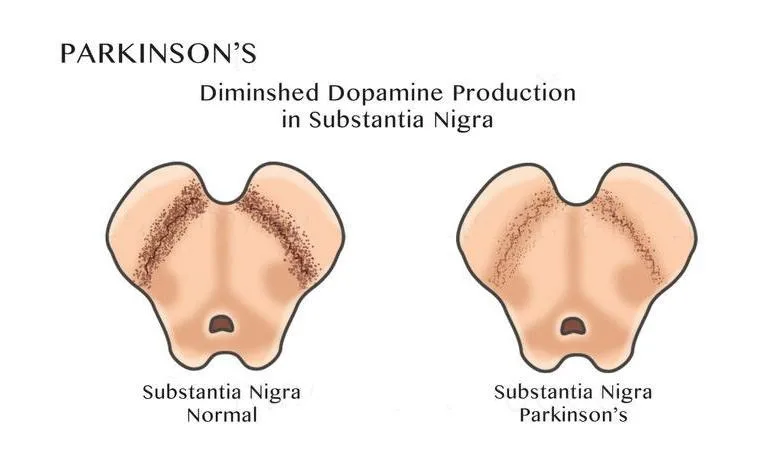
- Parkinson’s disease affects the nerve cells in the substantia nigra of the brain that produce dopamine – a neurotransmitter messenger in the body that allows smooth co-ordinated movements.
- When a person has Parkinson’s disease, these dopamine producing cells start to degenerate and amount of dopamine produced in the brain decreases. Messages from the brain telling the body how and when to move are delivered abnormally, leaving a person incapable of initiating and controlling movements in a normal way.
- It is characterized by loss of approximately 60-80% of the dopamine producing neurons in substantia nigra before the motor symptoms appear, and a profound loss of dopamine in striatum.
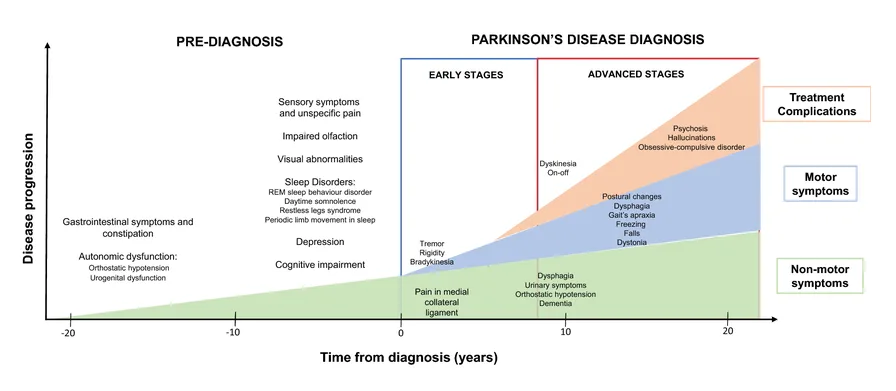 Chronology of clinical symptoms in Parkinson’s disease. Schematic representation of the diagnosis (even 10 to 20 years before the onset of the disease) and motor/non-motor symptoms in early and advanced Parkinson’s disease, with clinical and other iatrogenic symptoms.
What are the symptoms of Parkinson’s disease?
The symptoms of PD can be broadly classified as
- Motor symptoms
- Non-motor symptoms
➤ Motor symptoms of PD:
They usually start on one side of body & usually spread to the other side of body as the disease progresses. These are
-
- Tremors at rest of hands, legs, and/or jaw
- Slowness of speed of movements (bradykinesia)
- Stiffness of limbs (rigidity)
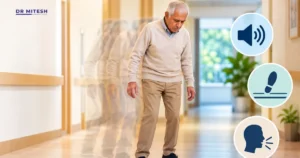
- Changes in posture, walking or balance difficulties
- Reduced facial expression (hypomimia)
- Difficulty in writing
- Change in voice quality or slurred speech (hypophonia, dysarthria)
- Difficulty in swallowing food (Dysphagia)
➤ Non-Motor Symptoms of PD:
They can occur earlier in the disease before motor symptoms emerge and may be present throughout the course of disease. These are
-
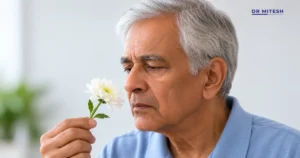
- Loss of smell sensations (hyposmia or anosmia)
- Altered taste sensations
- Memory decline (Dementia)
- Neuropsychiatric disturbances (depression, anxiety, hallucinations and psychosis)
- Constipation
- Sleep disturbances (inability to initiate or maintain sleep, excessive daytime sleepiness)
- Restless legs syndrome (RLS), REM sleep behavior disorder (RBD)
- Urinary problems
- Orthostatic hypotension
- Pain
- Abnormal excessive sweating or salivation
- Problems with controlling impulse e.g. compulsive shopping, eating, gambling and hypersexuality
If you or your family member notices any of these, please visit me for a Parkinson’s evaluation.
What are the stages of Parkinson’s disease?
-
- Stage 1: One side of body is affected
- Stage 2: Both sides of body affected but balance remains intact
- Stage 2.5: Both sides of body affected with mild impairment of balance
- Stage 3: Bilateral disease with impaired balance but functioning intact
- Stage 4: Moderate to severe bilateral disease; walking and standing difficult without help
- Stage 5: Wheelchair bound or bed-ridden
- Not everyone with PD will progress to stage 4 or 5.
- Parkinson’s disease affects everyone differently & a patient may or may not have all the possible symptoms.
- Adhering to medication treatment advised by your Parkinson’s disease and Movement disorders specialist is very essential.
My focus is to delay progression and help you stay active for as long as possible.
What is the “ON-OFF” phenomenon?
As PD progresses, patients may experience “ON-OFF” periods.
“OFF” periods are times when dopamine levels are low in the brain, and when the medicine is wearing off or not felt when it should be, presenting as motor or non-motor fluctuations. While “ON” periods are those when the patient doesn’t experience any motor (or non-motor) fluctuations and the effects of medications are good.
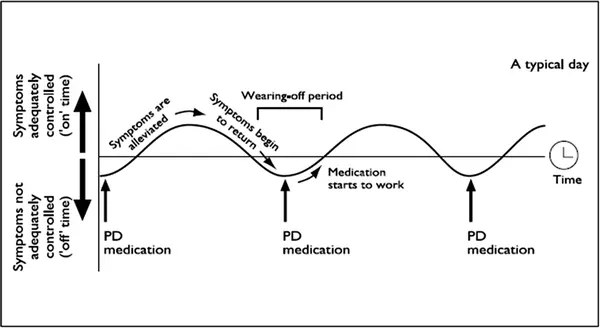 Illustration of a typical day in Parkinson’s disease, showing how medication controls symptoms, followed by a wearing-off period before the next dose.
What are dyskinesias?
Some patients may experience erratic involuntary movements upon long term treatment with levodopa. These are called as dyskinesia and can often be alleviated by adjusting dopaminergic medications.
Dyskinesias are involuntary, erratic, writhing movements of the face, arms, legs or trunk. They are often fluid and dance-like, but they may also cause rapid jerking or slow and extended muscle spasms. They are not a symptom of Parkinson’s disease itself rather, they are a complication from some Parkinson’s disease modifications.
How I Diagnose Parkinson’s Disease
There is no single test for Parkinson’s. I diagnose it based on:
-
- History of Your symptoms
-
- A detailed neurological examination
-
- Response to medicines like levodopa
-
- Sometimes a brain MRI to rule out other conditions
I take time to explain the diagnosis clearly and answer your questions so you feel confident about your care.
Treatment Options I Offer
Parkinson’s disease cannot be cured, but treatment can improve symptoms and make life easier.
1. Medicines
I create a customized plan using:
-
- Levodopa
-
- Dopamine agonists
-
- MAO-B inhibitors
-
- Other support medicines for sleep, anxiety, or digestion
The goal is to reduce stiffness, shaking, and improve movement. I adjust doses over time depending on your stage and response.
2. Deep Brain Stimulation (DBS)
If medicines are not working well anymore, or you have ON-OFF symptoms or dyskinesia, I may recommend DBS.
DBS is a type of brain surgery where a small device (like a pacemaker) is placed in the brain to improve movement signals.
I help with:
-
- Choosing the right time
-
- Planning the surgery
-
- Programming the battery after the procedure
-
- Long-term follow-up
It is safe, effective, and life changing in selected patients.
3. Supportive Therapies
-
- Physiotherapy – for walking and balance
-
- Speech therapy – for low voice or swallowing issues
-
- Diet guidance – to avoid constipation or weakness
-
- Counseling – for depression or anxiety
Together, we treat both body and mind.
Why Choose Me as Your Parkinson’s Specialist?
-
- Fellowship-trained in Movement Disorders
-
- Treated 1000+ Parkinson’s patients
-
- Expert in DBS and advanced therapies
-
- Simple explanations and personal attention
-
- Focus on long-term planning and family education
You are not alone in this journey. I’ll walk with you every step.
Frequently Asked Questions (FAQs)
Is Parkinson’s curable?
No, but it is manageable. With the right medicines and care, you can live well for many years, Read More.
What causes Parkinson’s?
We don’t know exactly. It may be related to age, genes, or environment. It’s not contagious, Read More.
How soon should I start treatment?
The earlier, the better. Early treatment slows down symptoms and protects your independence, Read More.
Is DBS safe?
Yes, in selected patients, DBS is very effective and safe. I guide you from start to finish, Read More.
Can diet or exercise help?
Yes! Regular movement, a healthy diet, and good sleep all support better results with treatment, Read More.
Ready to Take Control of Parkinson’s?
If you think you or your loved one may have Parkinson’s disease, don’t wait. I’m here to help you with understanding, treatment, and care that works.
Book Your Appointment Today
 Call: 8866843843
 Medisquare Superspeciality Hospital, Ahmedabad