
As a Neurologist for Dystonia, I help patients manage abnormal postures, muscle pulling, and twisting movements using advanced treatments like Botulinum Toxin therapy. Whether you are newly diagnosed or living with symptoms for years, I offer safe and effective care to help you feel and move better. Learn what causes dystonia, how to recognize it, and how we treat it.
Hello, I’m Dr. Mitesh Chandarana
I’m a Movement Disorder Specialist and Neurologist in Ahmedabad. I treat many patients with Dystonia, a condition that causes involuntary muscle contractions, leading to twisting, pulling, or abnormal postures in different parts of the body.
Dystonia can be mild or severe. But whatever the type, my job is to help reduce discomfort, improve your movement, and make your daily life easier.
What Is Dystonia?
Dystonia is a Movement Disorder in which there is sustained or intermittent uncontrollable muscle contractions that result in either repetitive twisting movements or abnormal postures or both. These dystonic movements can be associated with tremors. Dystonia can affect one muscle, a group of muscles or entire body.
How is dystonia classified?
Dystonia is mainly classified based on body parts it affects.
- Focal dystonia – It is localized to one part of body.
- Segmental dystonia – It involves two or more contiguous body parts.
- Multifocal dystonia – It involves two or more non-contiguous body parts.
- Generalized dystonia – When it involves almost all body parts including trunk.
- Hemidystonia – When it involves one side of arm and leg.
What Causes Dystonia?
Majority of cases of dystonia do not have a specific cause which are called idiopathic dystonia. It is believed to originate from dysfunction of or damage to basal ganglia (a part of brain) and its circuitry which control the body movements.
Idiopathic dystonia can be of sporadic origin or genetic origin. Some forms of genetic dystonia are inherited in autosomal dominant fashion in which only one parent who carries the defective gene is needed to pass the disorder to their child. Each child of affected parent has 50% chances of acquiring the defective gene and the disease. While others are inherited in autosomal recessive fashion in which both parents require to carry one defective gene which they pass on to their child. The symptoms may vary widely in severity among the different members of same family.
Apart from this, there are certain acquired (or secondary) dystonia which result from environmental or other insult to brain.
This damage can be due to
- Brain stroke
- Brain trauma
- Tumor
- Infection
- Demyelination
- Hypoxic brain damage
- Cerebral palsy
- Drugs
- Toxins (such as lead, carbon monoxide, manganese)
I take a full medical and family history to understand what may be causing your dystonia.
What are different types of dystonia?
According to the body part it affects, there are different types of dystonia such as
- Blepharospasm: It is a focal dystonia that affects both eyes. It often starts with frequent blinking of both eyes followed by eventual intermittent or constant forceful closure of both eyelids (Below Image). However, the vision of patients remains intact. It typically occurs in elderly females.
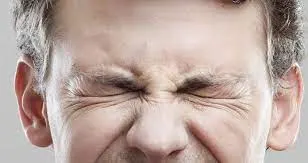 Highlighting the physical aspects of blepharospasm and focal dystonia conditions.
- Cervical Dystonia: It affects the neck muscles which causes the head to twist or tilt to one side or to the front or back (Below Image). It typically occurs in middle aged people. It can be disabling due to continuous or intermittent pulling of neck muscles as well as associated pain in the neck due to pulling and/or disc degeneration. Some patients also develop associated tremors of head-neck. Treatment options include antidystonia medications, botulinum toxin injection, and deep brain stimulation. Approximately 10% of cases with torticollis may experience a spontaneous remission, but unfortunately the remission may not be lasting.
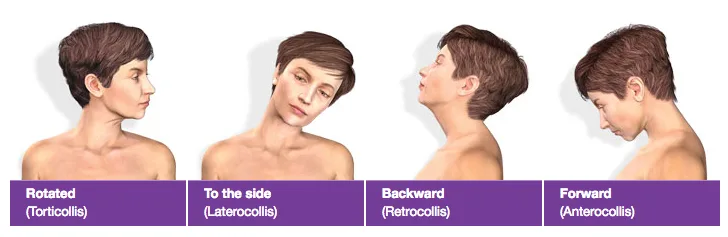 Types of head postures in cervical dystonia, including torticollis, laterocollis, retrocollis, and anterocollis.
- Task Specific Dystonia: it tends to occur in people who perform a particular skillful repetitive activity. The classical example of this is Writer’s cramp, which affects the muscles of hands and forearm only during writing. Other common examples of focal task specific dystonia are Musician’s dystonia, typist’s cramp, pianist’s cramp, and others. Musician’s dystonia leads to abnormal posturing of hand muscles in keyboard, guitar or violin players, mouth muscles and lip in wind players, and affects the voice in singers.
- Cranial Dystonia: It affects the muscles of head, and oro-facial region. Oromandibular dystonia (OMD) affects the muscles of jaw, lips, perioral region, and tongue. It can affect muscles of jaw opening, closure or deviation, and tongue which often leads to speaking and swallowing difficulty as well as involuntary tongue and lip bites. When OMD is accompanied by blepharospasm, it is called as Miege Syndrome. Sometimes, muscles of vocal cord get affected (known as Spasmodic dysphonia), which leads to strained or breathy speech.
How I Diagnose Dystonia
There’s no single test. Diagnosis is based on:
-
- Clinical symptoms
-
- Detailed neurological exam
-
- EMG in some cases
-
- Brain MRI (to rule out other problems)
-
- Genetic testing if needed (especially for younger patients or family cases)
My goal is to identify the type of dystonia, its cause, and how best to treat it.
What are the treatment options for dystonia?
1. Medical treatment:
Various class of medications have been found to be useful as “off-label” therapies for various forms of dystonia. In general, medications work well in patients with multifocal or generalised dystonia. The useful medications are anticholinergic agents (trihexyphenidyl and benztropine), dopaminergic agents (levodopa/carbidopa, and dopamine agonists in some cases), GABA agonists (baclofen, benzodiazepines such as clonazepam, lorazepam, diazepam), and dopamine depletors (tetrabenazine). These can be used either singly or in various combinations.
2. Botulinum Toxin Injection Administration
Botulinum toxin injections are the most effective form of treatment for focal and segmental dystonia such as blepharospasm, cervical dystonia, oromandibular dystonia, task specific dystonia and Meige syndrome. The toxin decreases muscle spasms by blocking release of the neurotransmitter acetylcholine, which normally causes muscles to contract.
The side effects are minimal due to its local action. Good benefit is seen in majority of cases when given by experienced hands. The effect of injections typically starts to appear in few days, and it is maintained for 3-4 months in majority of cases before the injections should be repeated.
3. Deep Brain Stimulation (DBS)
Deep Brain Stimulation (DBS) is recommended for few selected patients with segmental, cervical, and generalized dystonia, who fail to respond to multiple medications in fully tolerated doses, and/or multiple sessions of botulinum toxin injections. It involves surgically implantation of small electrodes in bilateral globus pallidus interna (GPi) region of brain that are connected to a implantable pulse generator in upper chest area. Controlled amounts of electricity are sent in pulse forms into GPi that generates the dystonic symptoms and interfere with and block the electrical signals that cause the symptoms, and leads to improvement of abnormal postures. The results of DBS are good in properly selected dystonia cases and are long lasting. It also involves follow-up adjustments in electrical parameters to optimize an individual’s DBS settings.
Types of Dystonia I Treat
-
- Cervical dystonia (neck twisting)
-
- Blepharospasm (eyelid spasms)
-
- Oromandibular dystonia (jaw or tongue pulling)
-
- Writer’s cramp
-
- Musician’s dystonia
-
- Spasmodic dysphonia (voice strain)
-
- Segmental or generalized dystonia
What Happens Without Treatment?
If dystonia is not treated:
-
- Movements may get worse
-
- Pain can increase
-
- Simple activities like speaking, writing, or eating may become difficult
-
- Social life and confidence may suffer
That’s why early care matters.
My Approach
-
- I explain everything in simple words
-
- I offer Botulinum Toxin injections safely and accurately
-
- I monitor your progress and adjust treatment
-
- I guide you through long-term planning if needed
Many of my patients feel relief within days after Botulinum Toxin and continue with regular follow-ups every 3-4 months.
Frequently Asked Questions (FAQs)
Q1. Is dystonia curable?
Not always, but it is highly treatable, especially with Botulinum Toxin (Botox), Know More.
Q2. Will Botox make my muscles weak?
I inject only the affected muscles, in safe doses. Some mild weakness may occur but usually improves in a few days, Know More.
Q3. How often do I need Botox?
Most people come once every 3 to 4 months for repeated treatment, Know More.
Q4. Can stress or fatigue make dystonia worse?
Yes, emotional or physical stress can worsen symptoms. Managing your health and routine helps too, Know More.
Q5. Is this condition life-threatening?
No, but it can affect your quality of life if left untreated, Know More.
Let’s Improve Your Movements Together
If you or someone you know is dealing with unusual movements, pulling, or muscle spasms, don’t wait. As a neurologist trained in dystonia care, I’m here to help you feel and move better.
Book Your Appointment Today
 Call: 8866843843
 Medisquare Superspeciality Hospital, Ahmedabad