
Being told that someone may have Corticobasal Degeneration (CBD) can feel confusing and emotionally overwhelming. Many patients and families spend months or even years searching for answers before receiving the correct diagnosis because the symptoms often resemble other neurological disorders such as Parkinson’s disease, Progressive Supranuclear Palsy, or atypical parkinsonism.
One of the most common questions families ask is:
“How do doctors diagnose CBD?”
Unlike some medical conditions, there is currently no single blood test or scan that confirms CBD immediately. Diagnosis usually involves a detailed neurological evaluation, symptom assessment, imaging tests, and ruling out other conditions that may look similar.
Understanding the diagnostic process can help reduce anxiety and prepare families for what to expect during neurological evaluation.
What Is Corticobasal Degeneration (CBD)?
Corticobasal Degeneration is a rare progressive neurological disorder that affects:
- Movement
- Coordination
- Thinking ability
- Speech
- Muscle control
The condition gradually damages specific areas of the brain involved in movement and higher brain functions.
CBD usually develops slowly and often begins with symptoms affecting one side of the body more than the other.
Learn more about-
- Cerebellar Ataxia Vs Sensory Ataxia: What’s the Difference?
- Huntington’s Disease Symptoms & Stages
Why CBD Is Difficult to Diagnose
One of the biggest challenges with CBD diagnosis is that its symptoms overlap with several other neurological conditions.
Early symptoms may resemble:
- Parkinson’s disease
- Progressive Supranuclear Palsy (PSP)
- Stroke
- Alzheimer’s disease
- Motor neuron disorders
Because symptoms evolve gradually, doctors may need time to observe how the condition progresses before confirming the diagnosis.
This is why some patients are initially diagnosed with Parkinson’s disease before CBD becomes clearer later.
Learn more about- Why MSA Is Often Misdiagnosed as Parkinson’s Disease
Common Early Symptoms That Lead to Evaluation
Patients usually seek medical attention because of progressive movement or coordination problems.
Common Early Symptoms Include:
- Stiffness in one arm or leg
- Clumsiness
- Difficulty using one hand
- Slowed movement
- Tremors
- Poor coordination
- Speech difficulty
- Balance problems
Some individuals may also experience:
- Cognitive changes
- Behavioral symptoms
- Difficulty performing familiar tasks
The pattern and progression of symptoms help neurologists narrow down possible causes.
Learn more about- Cerebellar Ataxia Vs Sensory Ataxia: What’s the Difference?
The First Step: Detailed Neurological Examination
The most important part of CBD diagnosis is a thorough neurological evaluation.
The neurologist carefully assesses:
- Muscle tone
- Reflexes
- Walking pattern
- Coordination
- Balance
- Eye movements
- Cognitive function
Doctors Often Look For:
- Symptoms affecting one side more prominently
- Stiffness resistant to movement
- Apraxia (difficulty performing learned movements)
- Abnormal posture
- Coordination problems
The clinical examination often provides the strongest clues toward diagnosis.
Understanding Apraxia in CBD
One feature that strongly suggests CBD is apraxia.
Apraxia means difficulty performing purposeful movements despite having normal muscle strength.
For example, a patient may:
- Struggle to button clothes
- Have trouble using utensils
- Find it difficult to wave goodbye
- Be unable to perform familiar hand movements
This symptom occurs because the brain has difficulty planning complex movements properly.
Apraxia is an important diagnostic clue in CBD.
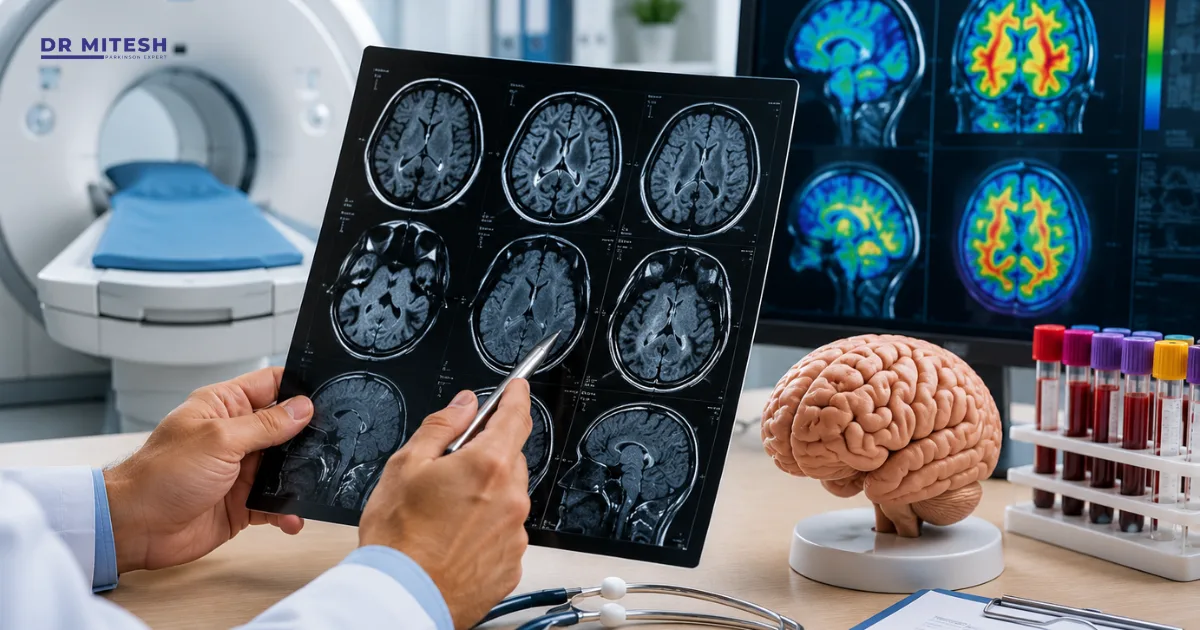
MRI Brain Scan: One of the Most Common Tests
An MRI brain scan is commonly ordered during evaluation.
Why MRI Is Important
MRI helps doctors:
- Rule out stroke
- Exclude tumors
- Look for brain shrinkage patterns
- Identify structural abnormalities
In CBD, MRI may sometimes show:
- Asymmetrical brain atrophy
- Shrinkage involving specific brain regions
- Changes affecting movement-control areas
However, MRI findings are not always definitive, especially in early stages.
PET Scan and Functional Brain Imaging
Some neurologists may recommend specialized brain imaging such as PET scans.
PET Scans Can Help:
- Evaluate brain metabolism
- Identify abnormal brain activity
- Support differentiation from other neurological disorders
PET imaging may reveal reduced activity in certain parts of the brain commonly affected in CBD.
These scans are usually used in specialized neurological centers rather than routine evaluation.
Blood Tests: Why They Are Still Important
Although no blood test confirms CBD directly, blood investigations help rule out other treatable conditions.
Common Blood Tests May Include:
- Vitamin B12 levels
- Thyroid function tests
- Autoimmune screening
- Infection-related testing
- Metabolic evaluations
These tests help ensure symptoms are not caused by reversible neurological conditions.
Cognitive and Memory Assessment
CBD can affect thinking and higher brain functions.
Doctors may therefore perform:
- Memory testing
- Attention assessments
- Language evaluation
- Executive function testing
Patients May Show:
- Difficulty planning tasks
- Reduced concentration
- Slower thinking
- Language difficulties
Cognitive assessment helps understand how extensively the brain is being affected.
Learn more about- Huntington’s Disease Symptoms & Stages
Speech and Swallowing Evaluation
As CBD progresses, speech and swallowing may become affected.
A speech-language specialist may evaluate:
- Speech clarity
- Voice strength
- Swallowing safety
- Communication ability
Why This Matters
Swallowing problems may increase the risk of:
- Choking
- Weight loss
- Aspiration pneumonia
Early evaluation allows timely therapy and nutritional planning.
Learn more about- Voice Tremor: Causes, Diagnosis and Treatment
Movement Disorder Specialist Consultation
Because CBD is rare and complex, many patients benefit from consultation with a movement disorder specialist.
These neurologists specialize in conditions such as:
- Parkinson’s disease
- PSP
- MSA
- Dystonia
- Corticobasal Degeneration
Specialized evaluation often improves diagnostic accuracy.
Difference Between CBD and Parkinson’s Disease
CBD is frequently mistaken for Parkinson’s disease during early stages.
Comparison Table
| Feature | CBD | Parkinson’s Disease |
|---|---|---|
| Symptoms affecting one side | Very common | Can occur |
| Apraxia | Common | Rare |
| Tremor | Less prominent | More common |
| Response to Parkinson’s medicines | Usually limited | Often better initially |
| Cognitive symptoms | Earlier | Usually later |
| Limb coordination problems | Common | Less severe initially |
Understanding these differences helps doctors distinguish between the disorders more accurately.
Why Diagnosis May Take Time
Families often become frustrated when diagnosis remains uncertain initially.
However, CBD diagnosis can be difficult because:
- Symptoms overlap with other disorders
- Early scans may appear normal
- Progression patterns take time to observe
- No single confirmatory test exists
Neurologists sometimes monitor symptom progression over multiple visits before finalizing the diagnosis.
Emotional Impact of Diagnostic Uncertainty
Waiting for answers can be emotionally exhausting.
Patients may feel:
- Anxious
- Confused
- Frustrated
- Fearful about the future
Caregivers often struggle with:
- Uncertainty
- Emotional stress
- Difficulty planning long-term care
Open communication with the neurologist can help families understand why careful observation is sometimes necessary.
Can Early Diagnosis Help?
Although there is currently no cure for CBD, early diagnosis still offers important benefits.
Benefits Include:
- Earlier physiotherapy
- Speech therapy
- Fall prevention planning
- Swallowing management
- Better caregiver preparation
- Emotional counseling
Early supportive care often improves safety and quality of life significantly.
Learn more about- PSP Early Warning Signs Before Diagnosis
What Happens After Diagnosis?
Management usually focuses on:
- Symptom control
- Rehabilitation
- Mobility support
- Fall prevention
- Communication assistance
Treatment Approaches May Include:
- Physiotherapy
- Occupational therapy
- Speech therapy
- Nutritional support
- Assistive devices
Supportive care becomes increasingly important as symptoms progress.
When Should You See a Neurologist?
Medical evaluation is important if someone develops:
- Progressive stiffness
- Coordination problems
- Difficulty using one hand
- Balance issues
- Speech changes
- Unexplained movement symptoms
Early neurological assessment helps rule out treatable causes and improves long-term planning.
Frequently Asked Questions (FAQ)
- Is there a blood test for CBD?
No, Currently, there is no specific blood test that confirms Corticobasal Degeneration. - Can MRI confirm CBD?
MRI may support the diagnosis, but it cannot confirm CBD by itself. - Why is CBD often mistaken for Parkinson’s disease?
Both conditions can cause stiffness, slowed movement, and balance problems during early stages. - What is apraxia in CBD?
Apraxia refers to difficulty performing learned movements despite normal muscle strength. - Does CBD affect memory and thinking?
Yes, Some patients develop cognitive and behavioral changes as the disease progresses.
Final Thoughts
Diagnosing Corticobasal Degeneration is often a gradual process that requires careful neurological evaluation, imaging studies, and long-term observation. Therefore taking the opinion of a neurologist who has the kno
Although the uncertainty can feel frustrating, understanding why diagnosis takes time can help patients and families approach the process with greater clarity and patience.
The most important step is seeking evaluation early when symptoms such as stiffness, imbalance, coordination difficulty, or unusual movement problems begin appearing.
Even though there is currently no cure for CBD, timely diagnosis allows access to supportive therapies, rehabilitation, caregiver planning, and symptom management that can meaningfully improve quality of life.
References
- National Institute of Neurological Disorders and Stroke – Corticobasal Degeneration Information Page
- Mayo Clinic – Corticobasal Degeneration Overview
- Cleveland Clinic – Corticobasal Syndrome Diagnosis and Management
- Movement Disorder Society – Clinical Guidance on CBD
- NHS – Corticobasal Degeneration Symptoms and Diagnosis
- Alzheimer’s Association – Corticobasal Syndrome and Cognitive Symptoms