Medically reviewed by Dr. Mitesh Chandarana | Last updated: July 2026
If you or a family member has been advised to undergo a sleep study to check for REM Sleep Behavior Disorder (RBD), the process can feel unfamiliar and, for some patients, a little intimidating. What exactly happens during the test? Do you need to stay overnight? Will it actually capture the behavior you’re worried about?
This guide walks through what an RBD diagnostic evaluation actually involves, step by step from the first consultation to the final report.
(If you’re looking for an introduction to what RBD is and its symptoms, our guide on Kicking or Punching in Sleep covers that. This piece focuses specifically on how the diagnosis itself is made.)
Step 1: Clinical History Comes First
Before any test is ordered, diagnosis starts with a detailed conversation. In my consultations, I focus on:
- What exactly happens during episodes – punching, kicking, shouting, jumping out of bed, or milder movements like reaching or gesturing
- Dream recall – a distinguishing feature of RBD is that patients, when woken during or after an episode, can often recall a vivid, action-driven dream that matches the physical behavior
- Timing within the night – RBD episodes typically occur during REM sleep, which is more concentrated in the second half of the night
- Bed partner’s account – since the person experiencing RBD is often unaware of their own movements, a partner’s description of what they’ve witnessed is frequently the most valuable piece of history
- Medication and substance history – certain antidepressants and other medications can trigger or worsen RBD-like symptoms, so ruling this out matters before assuming a primary neurological cause
- Associated symptoms – reduced sense of smell, constipation, or subtle changes in movement or handwriting can sometimes be relevant, since RBD is often studied alongside broader neurodegenerative risk
This history alone can make RBD highly likely, but a definitive diagnosis requires objective testing.
Step 2: Screening Questionnaires
Before arranging a full sleep study, I sometimes use validated screening tools such as the RBD Screening Questionnaire (RBDSQ) or the Mayo Sleep Questionnaire completed by the patient and, ideally, their bed partner. These aren’t diagnostic on their own, but they help determine how strongly a formal sleep study is indicated and can flag cases needing more urgent evaluation.
Step 3: The Sleep Study (Video Polysomnography)
This is the definitive diagnostic test for RBD. Here’s what it actually involves:
What It Measures
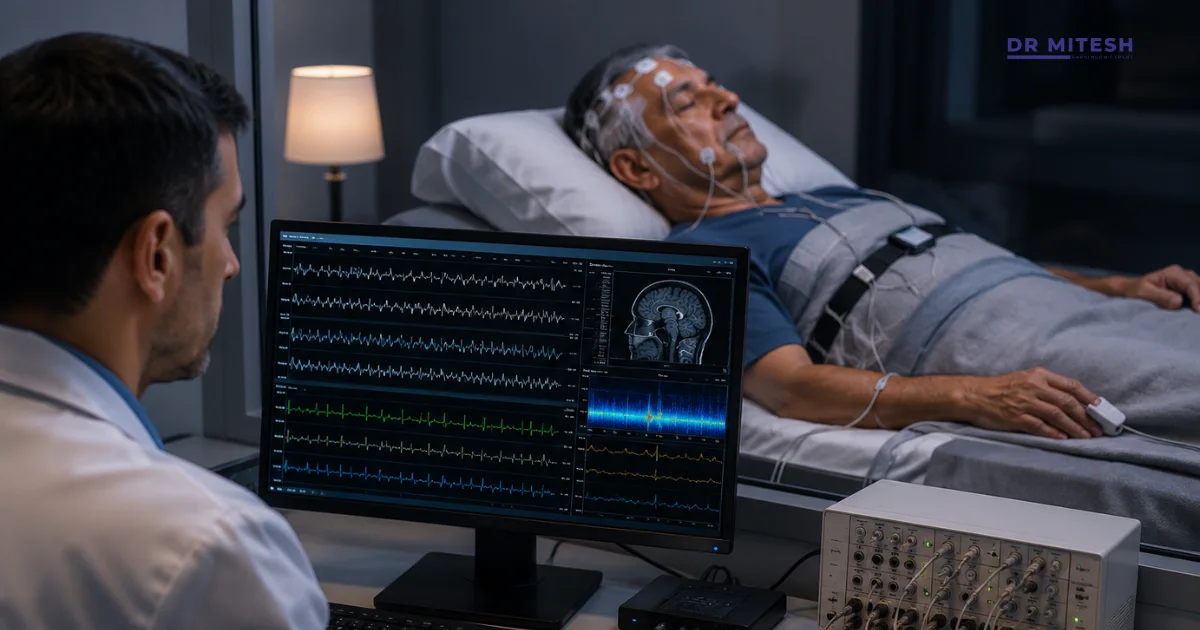
An overnight video polysomnography (PSG) study records several things simultaneously:
- Brain activity (EEG) – to identify sleep stages, including REM
- Muscle activity (EMG) – typically from the chin and limbs, to detect abnormal muscle tone during REM sleep
- Eye movements (EOG) – to confirm REM sleep periods
- Heart rhythm and breathing – to rule out other sleep disorders like sleep apnea that can sometimes mimic or coexist with RBD
- Synchronized video recording – so any physical behaviors can be directly matched to what the brain and muscles were doing at that exact moment
What the Test Is Looking For
The key diagnostic finding is called REM sleep without atonia (RSWA) normally, the body is almost completely paralyzed during REM sleep except for the eyes and breathing muscles. In RBD, this paralysis fails, allowing the muscles to remain active and the person to physically act out dream content.
What to Expect the Night Of
- You’ll typically arrive at the sleep lab in the evening and have sensors attached to your scalp, face, chin, chest, and legs – this is painless, though it can feel unusual at first
- A technician monitors the recording overnight from a separate room
- You’re free to move and reposition as you normally would; the sensors are designed to tolerate ordinary movement
- Most patients do sleep meaningfully during the study, even with the sensors attached, though some worry beforehand that they won’t
In my practice, I reassure patients that even a night with less-than-usual sleep quality can still yield a diagnostically useful study – the equipment is sensitive enough to catch what’s needed even if the overall sleep isn’t perfectly typical of a night at home.
Step 4: Interpreting the Results
After the study, the recorded data is reviewed for:
- Presence and degree of REM sleep without atonia
- Any captured behavioral episodes and whether they align with dream-enactment patterns
- Exclusion of other conditions that could explain the symptoms – sleep apnea, periodic limb movement disorder, or nocturnal seizures can sometimes present with overlapping features
A formal RBD diagnosis requires both the clinical history and the polysomnographic evidence of REM sleep without atonia – one without the other is generally not considered sufficient for a definitive diagnosis.
Why Getting a Proper Diagnosis Matters
Some patients ask whether a sleep study is really necessary if the symptoms already seem obvious. A few reasons it’s worth doing properly:
- It rules out mimics. Sleep apnea, night terrors, and certain seizure types can look similar to RBD from a description alone, but require completely different treatment.
- It documents a baseline. Since RBD can be an early marker followed for years, having an objective diagnostic record matters for long-term monitoring.
- It guides safety planning. Confirmed RBD severity helps determine what bedroom safety modifications (padding, removing sharp objects, separate sleeping arrangements if needed) are genuinely necessary versus precautionary.
What Happens After Diagnosis
Once RBD is confirmed, the conversation shifts to safety measures, treatment options (often starting with melatonin or, in some cases, clonazepam), and a monitoring plan since RBD is sometimes an early marker for other neurological conditions. This is covered in more detail in our guide on RBD as a warning sign.
If you or a family member is experiencing dream-enactment behaviors and hasn’t yet had a formal evaluation, a consultation with a movement disorder specialist or sleep specialist is the right first step before assuming either the best or worst-case explanation.
Authoritative References
- American Academy of Sleep Medicine – International Classification of Sleep Disorders, 3rd Edition (ICSD-3)
- StatPearls (NCBI) – REM Sleep Behavior Disorder
- UpToDate – Rapid Eye Movement Sleep Behavior Disorder