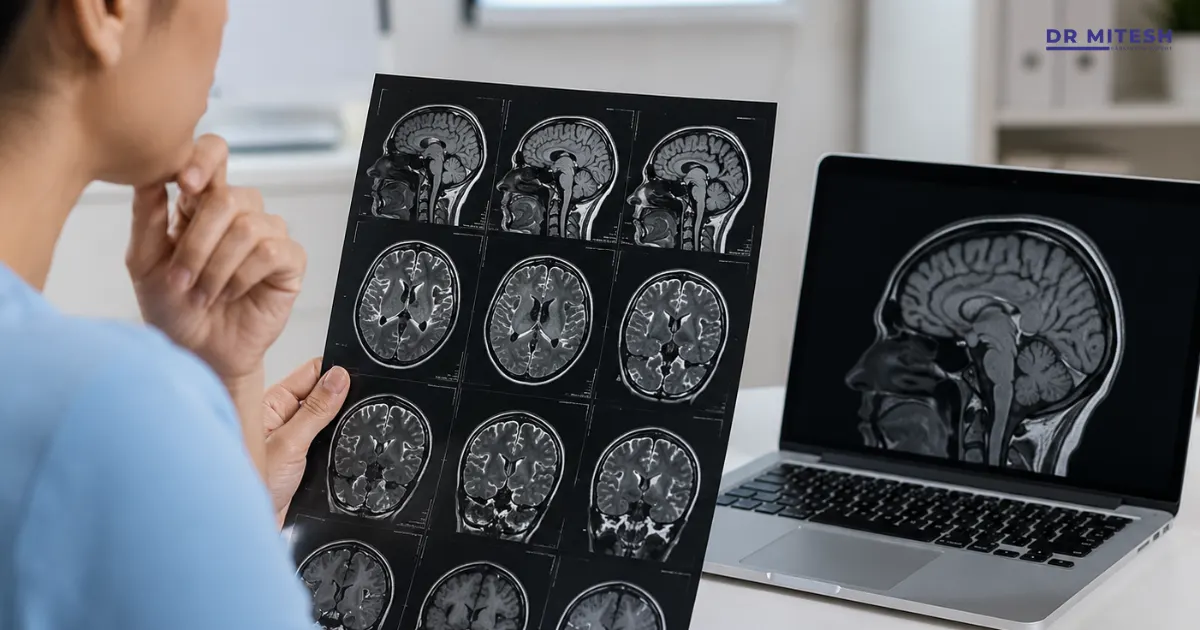

“My father had Parkinson’s disease. Will I get it too?”
This is one of the most emotional and important questions I hear from family members sitting across from me in the clinic. A parent, grandparent, or sibling has been diagnosed and now the family wonders: are we next?
The honest answer is nuanced. Parkinson’s disease can have a genetic component but for most people, having a family member with Parkinson’s does NOT mean you will develop it. The relationship between genes and Parkinson’s is more complex and more hopeful than many families fear.
Understanding Parkinson’s Disease
Parkinson’s disease is a progressive neurological condition caused by the gradual loss of dopamine-producing nerve cells in a part of the brain called the substantia nigra. This leads to the characteristic symptoms tremors, stiffness, slowness of movement, and balance problems.
What causes these brain cells to die? That is the central question and genes are just one part of the answer.
Is Parkinson’s Disease Hereditary?
The short answer: sometimes, but not always.
Parkinson’s disease falls into two broad categories when it comes to genetics:
1. Sporadic Parkinson’s Disease (Most Common – About 85–90% of Cases)
In the vast majority of patients, Parkinson’s occurs without a clear family history. It is called ‘sporadic’ because it appears to arise from a combination of ageing, environmental factors, and subtle genetic variations rather than a single inherited gene.
If you have sporadic Parkinson’s, the risk of your children developing it is only slightly higher than that of the general population not dramatically elevated.
2. Familial (Genetic) Parkinson’s Disease (About 10–15% of Cases)
In a smaller group of patients particularly those with young-onset Parkinson’s (under age 50) or a strong family history across multiple generations specific genetic mutations are responsible.
The most well-known genes associated with Parkinson’s disease include:
- LRRK2 (Leucine-rich repeat kinase 2) – the most common genetic cause of familial Parkinson’s
- PINK1 – commonly associated with young-onset Parkinson’s
- Parkin (PARK2) – another young-onset gene, often causing a slower disease course
- SNCA (Alpha-synuclein) – associated with rare, aggressive familial Parkinson’s
- GBA – mutations here increase risk but don’t guarantee disease development
Having one of these gene mutations does not automatically mean you will develop Parkinson’s. It means your risk is higher – not that it is certain.
What Is My Risk If a Family Member Has Parkinson’s?
This is what most families truly want to know. Let me break it down clearly:
If One Parent Has Parkinson’s (Sporadic Type)
Your risk of developing Parkinson’s is approximately 2–3 times higher than someone with no family history. In absolute terms, this still means your lifetime risk remains relatively low – roughly 4–9% compared to the general population risk of around 1–2%.
If a Parent Has a Known LRRK2 Mutation
The risk of inheriting the mutation is 50%. However, even if you inherit it, not everyone with LRRK2 mutations develops Parkinson’s. The ‘penetrance’ (chance the gene causes disease) varies significantly.
If a Sibling Has Young-Onset Parkinson’s
This warrants closer attention. Young-onset cases (before age 50) are more likely to have a genetic cause such as Parkin or PINK1 mutations. In these cases, genetic counselling and testing may be worth considering.
Genes Are Not the Whole Story – The Role of Environment
Even in families with known genetic mutations, not every member develops Parkinson’s. This tells us that genes alone are not sufficient, environment and lifestyle play a significant role in triggering or preventing the disease.
Factors that have been associated with a higher risk of Parkinson’s:
- Long-term exposure to certain pesticides and herbicides
- Head injuries (particularly repeated ones)
- Exposure to heavy metals like manganese
- Certain occupational exposures
Factors that may be associated with a lower risk:
- Regular physical exercise
- Caffeine consumption (some research suggests a protective effect)
- Anti-inflammatory diet rich in fruits and vegetables
The message here is powerful: even if you carry a genetic risk, your choices and environment can influence whether and when Parkinson’s develops.
Should Family Members Get Genetic Testing?
This is a question I discuss carefully with every family. The decision to pursue genetic testing is deeply personal.
When Genetic Testing May Be Recommended
- Young-onset Parkinson’s (diagnosed before age 50)
- Multiple family members across generations affected
- When the treating neurologist suspects a specific gene based on clinical pattern
- For research participation purposes
Important Caveats About Genetic Testing
- A positive result does NOT mean you will definitely develop Parkinson’s
- A negative result does NOT completely eliminate risk
- Currently, there is no proven preventive treatment even if a mutation is found
- Testing can cause significant emotional and psychological impact, counselling is essential
My recommendation: genetic testing should always be done alongside genetic counselling by a specialist — not just a simple blood test report.
What Should Families Do Practically?
Even without genetic testing, there are meaningful steps families can take when Parkinson’s runs in their history.
1. Learn to Recognise Early Warning Signs
Parkinson’s has several early non-motor signs that can appear years before movement problems begin:
- Loss of smell (without a cold or allergy)
- REM Sleep Behaviour Disorder – acting out dreams, talking or moving during sleep
- Constipation that is unexplained and persistent
- Mild depression or anxiety without an obvious cause
- Very soft handwriting that gets smaller over time (micrographia)
If you notice any of these in yourself or a family member, a consultation with a movement disorder specialist is worthwhile.
2. Stay Physically Active
Exercise is currently the strongest evidence-based strategy to support brain health and potentially slow neurodegeneration. Even 30 minutes of brisk walking, swimming, or cycling daily can make a meaningful difference.
3. Don’t Delay Seeking Evaluation
If symptoms appear – tremor, stiffness, change in walking – don’t wait and watch. Early diagnosis allows earlier treatment, which protects quality of life for longer.
4. Consider a Specialist Consultation Even Without Symptoms
If your parent or sibling has Parkinson’s particularly young-onset, a baseline consultation with a movement disorder specialist is valuable. This isn’t about alarming you; it’s about being informed and prepared.
“When a family comes to see me after a parent’s diagnosis, I always tell them: having Parkinson’s in your family is a reason to be informed not a reason to be afraid. Most people with a family history will never develop Parkinson’s. And for those who do, early awareness makes all the difference.”
A Word on Young-Onset Parkinson’s and Families
Young-onset Parkinson’s disease diagnosed before age 50 deserves special mention in any discussion about heredity. It is more likely to have a genetic basis, tends to progress more slowly, and responds particularly well to medicines.
If you or a family member is diagnosed young, I strongly recommend:
- A thorough family history review with your neurologist
- Discussion about whether genetic testing is appropriate
- Early and proactive treatment planning
- Regular follow-up with a movement disorder specialist who has experience with young-onset cases
Frequently Asked Questions
- If both my parents had Parkinson’s, does that mean I will definitely get it?
No, Even with two affected parents, there is no certainty. Parkinson’s involves many genes and environmental factors. A specialist consultation and possibly genetic testing can give you a clearer picture. - Can Parkinson’s skip a generation?
In genetic Parkinson’s, it is possible for a mutation to be ‘carried’ without causing disease in one generation and then manifest in the next. This is related to the concept of ‘incomplete penetrance’ in genetics. - My parent was diagnosed at age 72. Should I be worried?
Late-onset sporadic Parkinson’s (after age 60) carries a lower genetic risk for children compared to young-onset cases. While your risk is slightly elevated compared to the general population, it is not dramatically high. Staying informed and recognising early signs is the most practical approach. - Is there a blood test I can take to know if I’ll get Parkinson’s?
Currently, there is no reliable predictive blood test for Parkinson’s in the general population. Specific gene tests exist for known mutations (like LRRK2, PINK1, Parkin), but these are recommended in specific clinical contexts with genetic counselling not as routine screening.
Talk to a Specialist – Knowledge Is Protection
If Parkinson’s disease runs in your family, the most important thing you can do is stay informed, stay active, and stay connected with the right medical guidance.
As a movement disorder specialist in Ahmedabad with experience in both familial and sporadic Parkinson’s, I’m here to answer your questions honestly and without alarm.
Book a Consultation:
- Call / WhatsApp: 8238034080
- Email: care@parkinsongujarat.com
- Medisquare Superspeciality Hospital, Gurukul, Ahmedabad
- Marengo CIMS Hospital, Sola, Ahmedabad
Website: parkinsongujarat.com