
Medically reviewed by Dr. Mitesh Chandarana | Last updated: September 2026
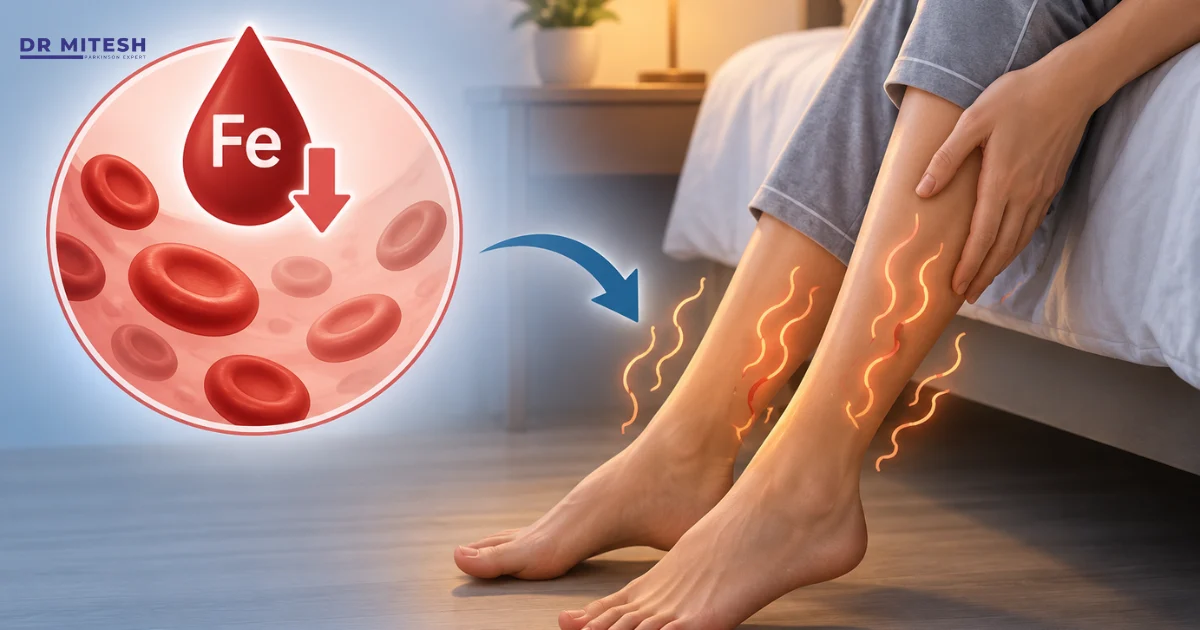
Of all the potential causes and contributors to Restless Legs Syndrome (RLS), iron deficiency is one of the most important because unlike many other factors, it’s directly testable and, in many patients, directly correctable. Yet it’s also one of the most commonly overlooked, partly because standard blood tests don’t always flag it clearly.
(For a general introduction to RLS, see our guide on Is Restless Legs Syndrome Dangerous? A Simple Guide. This piece focuses specifically on the iron connection.)
Why Iron Matters for RLS
Iron plays a direct, well-established role in the brain’s dopamine system. Specifically, iron is a necessary cofactor for tyrosine hydroxylase, the enzyme responsible for producing dopamine. When brain iron levels are low – even when blood iron levels appear technically normal – dopamine production and signaling can be disrupted in ways that are now understood to directly contribute to RLS symptoms.
This is why RLS is sometimes described as having a similar underlying dopamine-related mechanism to Parkinson’s disease, despite being a very different condition both involve dopamine system disruption, though through different specific pathways.
The Key Detail Most Patients Don’t Know: Ferritin Thresholds Are Different for RLS
This is the single most important practical point in this entire topic. Standard lab reference ranges for “normal” ferritin (the protein that stores iron in the body) are typically much lower than what’s now considered optimal for RLS specifically.
- Standard lab “normal” ferritin often starts around 15-30 μg/L, depending on the lab
- For RLS specifically, research and clinical guidelines suggest symptoms are more likely to improve with iron supplementation when ferritin is below approximately 75 μg/L – a much higher threshold than what’s flagged as “deficient” on a standard report
In my practice, this is a detail I specifically check for in every RLS patient – a ferritin level that a general physician might read as “normal” can still be functionally low enough to be driving RLS symptoms. Relying on the lab’s default reference range alone can mean missing a genuinely correctable cause.
Who’s Most at Risk of Iron-Related RLS
- Women, particularly those with heavy menstrual periods – a common and often under-recognized cause of iron deficiency
- Pregnant women – iron demands increase substantially during pregnancy, and RLS often first appears or worsens during this time
- Patients with chronic kidney disease – iron metabolism is frequently disrupted in CKD, and RLS is notably more common in this population, especially in those on dialysis
- Frequent blood donors – repeated donation can gradually deplete iron stores
- Patients with restrictive diets or absorption issues – including some gastrointestinal conditions that impair iron absorption
How Iron Deficiency Is Assessed in RLS
A proper workup typically includes:
- Serum ferritin – the primary test, interpreted against the RLS-specific threshold rather than the standard lab reference range
- Transferrin saturation – provides additional information about how much of the body’s iron-transport capacity is actually being used
- Complete blood count – checks for anemia, though it’s important to note that iron deficiency significant enough to contribute to RLS can be present even without anemia
Treatment Approaches
Oral Iron Supplementation
For many patients, oral iron supplements are the first step, generally recommended to be taken with vitamin C (which improves absorption) and away from calcium, coffee, or tea (which can reduce absorption). Response is typically monitored with repeat ferritin testing after a few months, since correcting iron stores takes time.
Intravenous Iron
For patients who don’t tolerate oral iron well, don’t respond adequately, or have significantly low ferritin, intravenous iron infusion is an option. Clinical research has shown meaningful improvement in RLS severity with IV iron in appropriately selected patients, sometimes producing a more substantial and quicker response than oral supplementation.
What Iron Supplementation Won’t Do
It’s worth setting realistic expectations: correcting iron deficiency helps a genuine subset of RLS patients significantly, but it isn’t a universal cure for everyone with RLS – some patients have normal iron status and require other treatment approaches, and some with genuinely low iron still need additional RLS-specific medication alongside iron correction.
An Important Caution: Don’t Self-Supplement Without Testing
Because iron overload also carries real health risks affecting the liver and other organs over time – iron supplementation for RLS should always be guided by actual ferritin testing, not started independently based on symptoms alone. This is particularly important for men and postmenopausal women, who are more prone to iron accumulation than iron deficiency compared to premenopausal women.
What to Do Next
If you have RLS and haven’t had your ferritin level specifically checked and interpreted against the RLS-relevant threshold not just the standard “normal” range – this is a reasonable, low-risk step worth discussing with your neurologist. For many patients, it’s one of the more straightforward and correctable pieces of the RLS puzzle.
Living with restless legs and haven’t had a proper iron workup? Getting the right tests interpreted correctly makes a real difference. Book a consultation with Dr. Mitesh Chandarana, one of the best movement disorder specialists in Ahmedabad.