
Medically reviewed by Dr. Mitesh Chandarana | Last updated: October 2026
Everyone has had an eyelid twitch after a late night or too much coffee. Blepharospasm is something different. It is a form of dystonia in which the muscles around the eyes contract involuntarily, causing frequent blinking, forceful squeezing, or in more severe cases, eyelids that stay shut for seconds or minutes at a time. It usually begins in adulthood, often goes unrecognised for a long time, and is frequently treated first as a dry-eye or stress problem.
(Blepharospasm is one of several focal dystonias. For the broader picture, see our guide on Botulinum Toxin Therapy for Dystonia & Spasms.)
What Blepharospasm Is
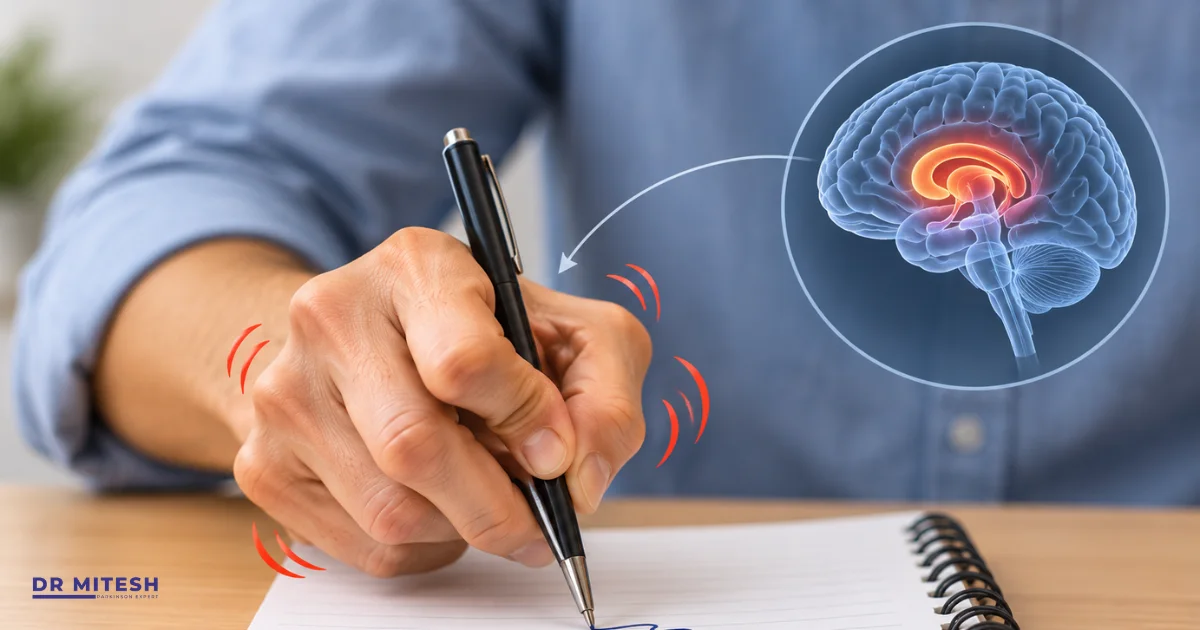
The muscle that closes the eyelids (the orbicularis oculi) is controlled by brain circuits in the basal ganglia, the same deep brain region involved in movement control. In blepharospasm, these circuits send the muscle excess signals. The most common form is called benign essential blepharospasm. “Benign” here means it is not life-threatening, but it can be seriously disabling. Most cases occur in people with no family history.
How It Typically Begins and Progresses
- Early stage: an increased blink rate, a feeling of irritation or grittiness in the eyes, and sensitivity to bright light
- Middle stage: blinking becomes forceful, and spasms are set off by bright light, wind, reading, driving, screens, or stress
- Advanced stage: the eyelids can stay clamped shut for long periods. The eyes themselves are healthy, but the person cannot open them, which is sometimes called “functional blindness.” This can make walking, crossing roads, and driving unsafe
Both eyes are usually affected, and symptoms often ease during sleep and when concentrating on an absorbing task.
The “Sensory Trick”
Many patients discover a small physical action that briefly relaxes the spasm. Common examples include touching the eyebrow or the side of the face, pulling gently at the eyelid, humming, talking, chewing gum, or wearing glasses. This is a recognised feature of dystonia and is a useful clue for diagnosis.
Is It Blepharospasm or Something Else?
Several conditions can look similar, and sorting them out is the main diagnostic task:
- Ordinary eyelid twitching from fatigue, stress, or caffeine is brief, usually affects one eyelid, and settles on its own
- Dry eye or eye surface disease can cause increased blinking and can also contribute to blepharospasm. It is common for both to be present together
- Hemifacial spasm affects one side of the face, not both eyes together
- Tics are usually preceded by an urge to blink and can be briefly suppressed
- Apraxia of eyelid opening is not a spasm but difficulty starting to open the eyes, even though the eyelid muscle is not contracting. It is seen in some people with Parkinson’s disease and related conditions
- Drooping eyelid (ptosis) from conditions such as myasthenia gravis can also be mistaken for blepharospasm
In my practice, a common story is a patient who has seen several doctors and used many eye drops over a year or two before the diagnosis is made. If lubricating drops are not helping and the blinking is getting more forceful or more triggered by light, ask for a neurological assessment.
Blepharospasm, Meige Syndrome, and Other Dystonias
Blepharospasm sometimes spreads to the lower face, jaw, and tongue. When blepharospasm occurs together with jaw and mouth dystonia (oromandibular dystonia), the combination is called Meige syndrome. Some patients also develop dystonia in the neck, so a full examination is worthwhile.
Blepharospasm in Parkinson’s and PSP
Blepharospasm is usually an isolated condition, but it can also occur with other movement disorders. It is a recognised feature in some patients with progressive supranuclear palsy, where botulinum toxin can help eyelid spasm. See our guide on PSP Treatment Options.
It is important not to confuse blepharospasm with the eye changes of typical Parkinson’s disease, where blinking is usually reduced, not increased, and the eyes tend to become dry. That is covered in Does Parkinson’s Affect Eyesight?
Treatment Options
Botulinum toxin injections
This is the main treatment for blepharospasm. Tiny doses are injected around the eyes to weaken the muscle just enough to reduce spasms. Most people notice improvement within several days, and the effect usually lasts around three months, so injections are repeated on a regular schedule. Possible side effects are usually temporary and include a drooping eyelid, dry or watery eyes, and occasionally double vision. For more on safety, see Are Botulinum Injections Safe?
Treating the eye surface
Lubricating drops, treatment of eyelid inflammation, and dry-eye care can reduce a trigger that makes spasms worse, even though they do not cure the dystonia.
Light-management measures
- Tinted or wraparound glasses can reduce light sensitivity. Some people find specially tinted lenses helpful
- A wide-brimmed hat and sunglasses outdoors
- Adjusting screen brightness and lighting at work and home
Oral medicines
Tablets are sometimes tried, but the benefit is generally modest and side effects can limit their use, so they are usually an add-on rather than the main treatment.
Surgery
For the small number of patients who do not respond adequately to injections, surgical options exist, including removal of part of the eyelid muscles, and in rare cases deep brain stimulation. These are specialist decisions.
Practical Tips for Daily Life
- Take extra care when driving, and speak to your doctor if your eyes close involuntarily while you drive
- Take regular screen breaks and use larger text or voice tools when reading is difficult
- Learn which triggers affect you most and plan around them
- Do not hide the condition. Blepharospasm is often misread as rudeness, sleepiness, or nervousness, and a brief explanation to colleagues and family helps
- Seek support if embarrassment or low mood is affecting your social life or work
Whom to See
An eye examination is a sensible first step to rule out dry eye and other eye problems. If the blinking is persistent, bilateral, and getting worse, a movement disorder specialist can confirm blepharospasm, check for dystonia elsewhere, and start treatment.
Excessive blinking or eyelid spasms that aren’t improving? A correct diagnosis opens up effective treatment. Book a consultation with Dr. Mitesh Chandarana, one of the best movement disorder specialists in Ahmedabad.