
Health education content. Medically reviewed by Dr. Mitesh Chandarana
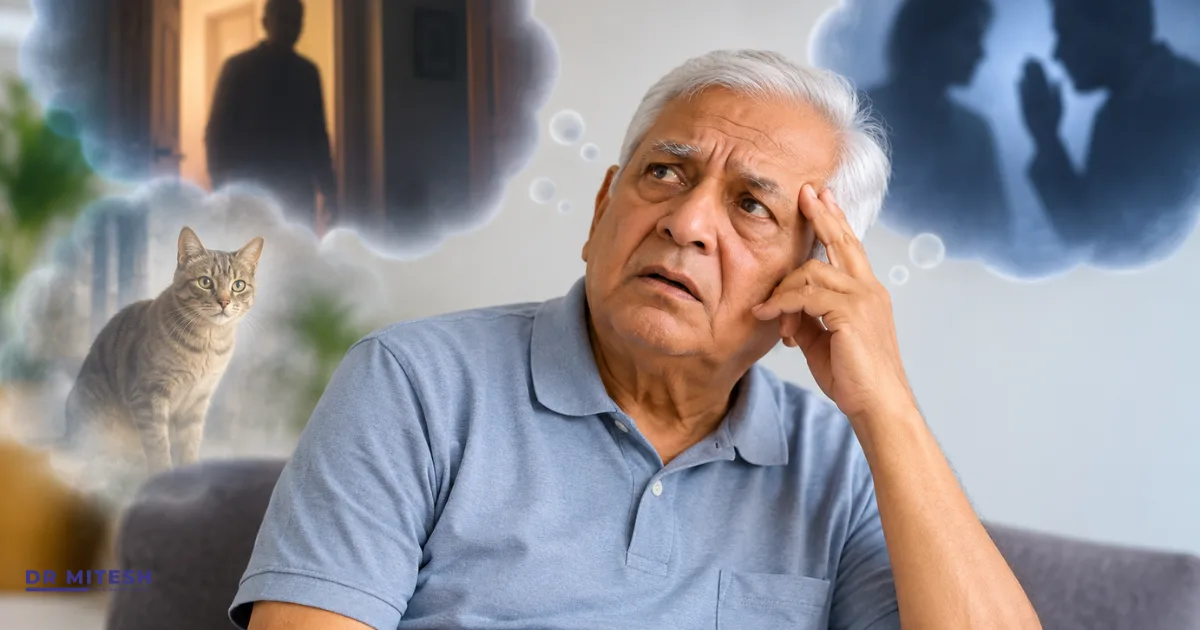
Many families are surprised to learn that Parkinson’s disease can affect perception and thinking as well as movement. A person with Parkinson’s may see people or animals that are not there, or hold firm beliefs that are not true. Together these symptoms are called Parkinson’s disease psychosis. They can be frightening for the person and for the family, and they are often not mentioned to the doctor because of fear or embarrassment. They are a recognised part of Parkinson’s for some people, and they are not a sign that the person is “going mad.”
How Common Are They?
Estimates vary between studies, and the risk rises with longer disease duration. Some sources report that up to about half of people with Parkinson’s experience hallucinations or related symptoms at some point. Many have mild symptoms. Having them does not mean a person will definitely develop dementia, although the two are linked (see Parkinson’s and Dementia: Understanding the Connection).
What They Can Look Like
Hallucinations
A hallucination is seeing, hearing, feeling, tasting, or smelling something that is not there. In Parkinson’s, visual hallucinations are the most common. Symptoms often progress in stages:
- Minor symptoms: a sense that someone is present in the room, or a fleeting shape or movement at the edge of vision
- Illusions: mistaking a real object, such as a coat on a hook or a pattern on the curtain, for a person or animal
- Formed hallucinations: clearly seeing people, children, or animals, often silent and often at dusk or in the evening
- Other senses: hearing voices or sounds, feeling touch on the skin, or smelling things that are not there, which are less common
Early on, many people know that what they see is not real. Over time, some lose that insight.
Delusions
A delusion is a firm belief that is not true and that cannot be changed by explanation. Themes that are described in Parkinson’s include suspicion that a spouse is unfaithful, belief that people are stealing from them or plotting against them, or belief that a family member has been replaced. Delusions are generally more distressing and more disruptive than mild hallucinations.
Why Do They Happen?
There is usually more than one contributing factor:
- Parkinson’s medicines. Dopamine-related medicines, particularly at higher doses, and some other medicines used in Parkinson’s can trigger or worsen hallucinations. Many other common medicines, such as sedatives and some pain medicines, can have a similar effect.
- Changes in the brain from Parkinson’s itself, especially in longer-standing disease.
- Memory and thinking changes.
- Poor sleep and vivid dreams. Sleep disturbance, including REM sleep behaviour disorder, is associated with hallucinations.
- Poor vision or hearing, and dim or shadowy lighting. See Does Parkinson’s Affect Eyesight?
- Medical triggers such as infections (including urinary infections), dehydration, constipation, or low sodium.
- Hospital stays or surgery, which can bring on confusion.
Hallucinations or Delirium?
These can look alike but need different responses. Delirium is a sudden state of confusion, usually developing over hours to days, with drowsiness, disorientation, or fluctuating alertness. It is often caused by an infection or another medical problem and needs prompt medical assessment. If a person becomes suddenly confused or markedly different from usual, seek medical attention without delay.
When Hallucinations Appear Early
Hallucinations that appear very early, before or alongside the first movement symptoms, together with fluctuating alertness and memory changes, may point toward a related condition called dementia with Lewy bodies. See Parkinson’s Plus Syndromes. A neurological assessment can help sort this out.
Should the Doctor Be Told?
Yes, Many families wait, hoping the symptoms will pass, and the doctor learns about them only when they have become severe. Mild hallucinations in which the person keeps insight and is not distressed may be monitored. Treatment is more likely to be needed if symptoms are frightening, are getting worse, include delusions, or put the person or others at risk.
How Doctors Approach Treatment
- Look for triggers: infection, dehydration, poor sleep, low sodium, constipation, pain, or new medicines.
- Review medicines: the doctor may simplify the regimen, remove medicines that are most likely to cause hallucinations, or adjust doses step by step. Parkinson’s medicines should never be stopped suddenly, because this can cause serious problems.
- Consider medicines for psychosis if needed: only a few antipsychotic medicines are considered suitable for people with Parkinson’s. Many commonly used antipsychotics can make Parkinson’s movement symptoms much worse. Examples that doctors may consider include quetiapine, clozapine, or, where available, pimavanserin. A person with Parkinson’s should not be given an antipsychotic without the neurologist’s input.
- Treat related problems: if memory problems are present, a cholinesterase inhibitor may be used. Depression, anxiety, and sleep problems also need attention.
Response varies. Symptoms improve in some people after adjustments, while in others they persist and need ongoing review.
How Families Can Respond
- Stay calm and reassure. A quiet, steady tone helps more than correction.
- Do not argue about whether it is real. Arguing rarely helps. You can acknowledge that the experience feels real to them while saying that you do not see it.
- Check the surroundings. Reduce shadows, reflections, mirrors, and patterned fabrics that can be misread. Keep rooms well lit in the evening.
- Make sure glasses and hearing aids are worn and working.
- Keep routines predictable, and keep nights as quiet and calm as possible.
- Gently redirect to a pleasant activity, a change of room, or a familiar person.
- Keep a simple diary of when episodes happen, what the person was doing, and any recent medicine changes. This helps the doctor.
- Prioritise safety. Reduce fall hazards, especially at night, and keep potentially harmful items out of reach if the person is frightened or suspicious.
- Look after yourself. Living with a loved one’s psychosis can be exhausting. See Caregiver Burnout: Recognizing It and What Actually Helps.
When to Seek Urgent Medical Help
Seek help promptly if there is sudden confusion or drowsiness, fever, new aggression or agitation, refusal to eat, drink, or take medicines, a risk of harm to the person or others, or any talk of self-harm. In India, the Tele-MANAS mental health helpline is 14416. In an emergency, contact local emergency services.
About the reviewing doctor: Dr. Mitesh Chandarana, MBBS, MD (Internal Medicine), DM (Neurology), Fellowship in Movement Disorders (SCTIMST). Clinic address and appointment contact details are on the contact page.
This article is for general health education and is not a substitute for individual medical advice.