Medically reviewed by Dr. Mitesh Chandarana | Last updated: October 2026
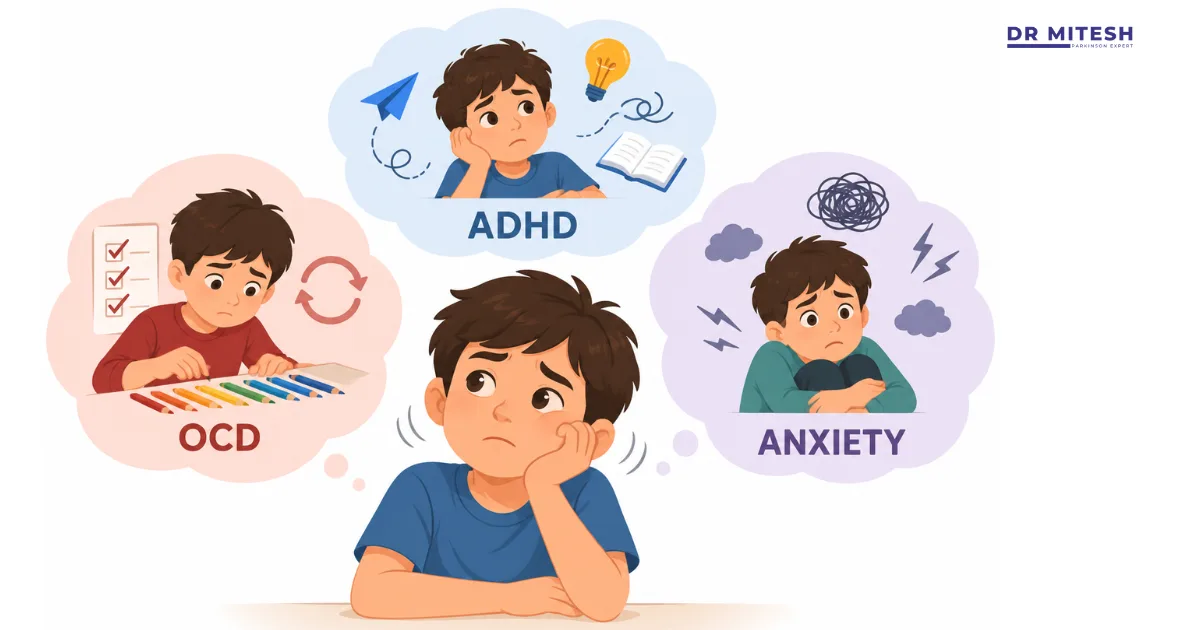
Families of children with tics often expect the main concern to be the tics themselves. In practice, other difficulties frequently come along with Tourette syndrome and other chronic tic disorders: trouble concentrating, repeated “just right” routines, constant worry, or emotional meltdowns after a day of holding tics in. These are recognised co-occurring conditions, and for many people they affect daily life as much as, or more than, the tics.
(For an overview of the condition, see Tourette Syndrome: Tics, Symptoms and Management. This article covers the conditions that commonly occur alongside it.)
How Common Are Co-Occurring Conditions?
Studies of people with Tourette syndrome find that a large proportion have at least one additional condition. The most frequently reported are:
- ADHD (attention-deficit/hyperactivity disorder)
- OCD (obsessive-compulsive disorder) and obsessive-compulsive behaviours
- Anxiety disorders
- Depression and low mood
- Learning difficulties, sleep problems, anger outbursts, and in some people, self-injurious behaviour
Researchers think this clustering reflects shared brain circuits involved in movement, attention, habit formation, and emotion. Tics often become milder after adolescence, but ADHD and OCD symptoms can continue into adulthood in some people.
ADHD and Tics
ADHD is one of the most commonly reported companions of Tourette’s. In many children, attention and hyperactivity difficulties appear before the tics.
- Typical features: difficulty sustaining attention, restlessness, impulsive behaviour, and trouble finishing tasks or following instructions.
- Link with tics: research suggests children with ADHD may find it harder to suppress tics, and stress from untreated ADHD can make tics more noticeable.
- Treatment: ADHD can be treated alongside tics. Earlier practice was cautious about stimulant medicines in children with tics. More recent evidence suggests they do not worsen tics in most children, although individual responses vary. Behavioural approaches and other medicines are also used. Choices should be made with the treating doctor.
OCD and Tics
Tics and OCD share a similar pattern: an uncomfortable feeling builds, and a repeated action brings relief. Research shows that a meaningful share of people with Tourette’s also meet criteria for OCD. Some have a pattern sometimes called “Tourettic OCD,” in which compulsions look and feel much like complex tics.
| Tics | OCD compulsions | |
|---|---|---|
| What comes first | A physical or sensory “premonitory urge,” such as an itch or tension | An intrusive thought or fear that causes anxiety |
| Purpose of the action | To relieve the urge; there may be no reason attached | To reduce anxiety or prevent something feared |
| Typical examples | Blinking, shoulder jerks, throat clearing, touching | Checking, washing, counting, arranging until it feels right |
The two can overlap, and the line between a complex tic and a compulsion is sometimes blurry. The distinction matters because treatment differs. Research suggests OCD that occurs together with tics may respond less fully to a standard first-line medicine used on its own, which is why a specialist assessment is useful. Exposure and response prevention, a form of cognitive behavioural therapy (CBT), is an evidence-based treatment for OCD.
Anxiety and Tics
- Anxiety and tics influence each other: anxiety can increase tics, and the unpredictability and embarrassment of tics can increase anxiety.
- Many children suppress tics at school and release them at home, which can appear as irritability or meltdowns after school.
- Possible signs of anxiety include avoidance of school or friends, constant worry, stomach aches or headaches, and trouble sleeping.
- CBT and relaxation skills are commonly used, and medicines are sometimes added. Comprehensive Behavioural Intervention for Tics (CBIT) is a behavioural therapy aimed at the tics themselves.
Other Difficulties That Can Occur
Low mood or depression, sleep problems, learning difficulties, and anger outbursts are also reported more often in people with tic disorders. They are worth mentioning to the treating doctor, because each has its own assessment and management.
Deciding What to Address First
When several conditions occur together, clinicians commonly ask which problem is causing the most difficulty in daily life, and plan around that. Sometimes this is not the tics. It may be school performance, bedtime rituals, or school avoidance. Mild tics may not need medicine at all.
How Evaluation Usually Works
- A detailed history from parents, and from teachers where possible, covering when each symptom began and how it affects school, friendships, and home life.
- Screening for ADHD, OCD, anxiety, depression, sleep problems, and learning difficulties.
- A review of other possible causes, including medicines and medical conditions.
- A care plan agreed with the family, which may involve a neurologist, a psychologist or psychiatrist, and the school.
What Families Can Do
- Try to tell the symptoms apart. A tic is not defiance, a compulsion is not stubbornness, and poor focus is not laziness.
- Keep routines predictable and reduce avoidable stress.
- Avoid punishing tics or repeatedly pointing them out.
- Share the whole picture with teachers so that school support covers attention and anxiety as well as tics. See Tic Awareness in Schools.
- Protect sleep, physical activity, and unstructured downtime.
- Pay attention to mood. Persistent sadness, withdrawal, or any talk of self-harm needs prompt professional attention. In India, the Tele-MANAS mental health helpline is 14416.
When to Seek Medical Advice Promptly
Seek medical advice soon if tics, OCD symptoms, or behaviour change suddenly and severely over days to weeks (particularly after an infection), if tics are causing injury, if there is self-harm or thoughts of self-harm, or if school, friendships, or family life are breaking down.
Outlook
The course varies from person to person. Tics often lessen after adolescence, while ADHD, OCD, and anxiety may continue and need ongoing attention. For more on how tics change over time, see Tic Disorders in Children: Can They Improve Over Time?
About the reviewing doctor: Dr. Mitesh Chandarana, MBBS, MD (Internal Medicine), DM (Neurology), Fellowship in Movement Disorders (SCTIMST). Clinic address and appointment contact details are on the contact page.
This article is for general health education and is not a substitute for individual medical advice.
References
- Frontiers in Psychiatry (NCBI) – Tourettic OCD: Current Understanding and Treatment Challenges of a Unique Endophenotype
- PMC – Pharmacological Management of Tourette’s Syndrome Comorbid With Obsessive-Compulsive Disorder in Adult Patients
- Frontiers in Neuroscience – New Insights Into Tourette Syndrome: Finding in 1032 Patients