
Medically reviewed by Dr. Mitesh Chandarana | Last updated: August 2026
One of the most distinctive and most diagnostically important features of Progressive Supranuclear Palsy (PSP) is a specific eye movement problem: difficulty voluntarily looking downward. Patients often describe struggling to see food on their plate, missing steps while walking down stairs, or having trouble reading a book held in their lap not because of a problem with the eyes themselves, but because of how PSP affects the brain’s control over eye movement.
This symptom is so characteristic of PSP that it’s part of the formal diagnostic criteria, and understanding it helps explain several other PSP symptoms discussed elsewhere on this site, including why falls happen the way they do in PSP.
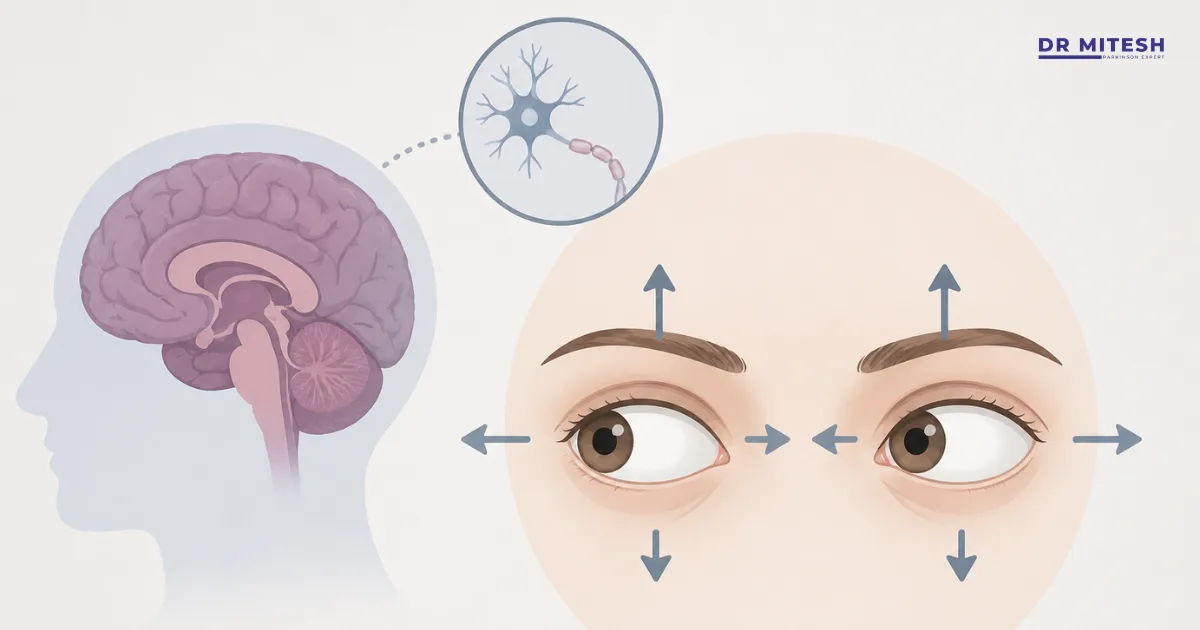
What’s Actually Happening: Vertical Supranuclear Gaze Palsy
The formal medical term for this symptom is vertical supranuclear gaze palsy often shortened to just “gaze palsy” in clinical conversation. Breaking down what this means:
- “Supranuclear” means the problem lies above the level of the actual eye-movement nerve centers (nuclei) in the brainstem – the eye muscles and the nerves directly connecting to them are completely normal
- The problem is in the brain’s higher-level control circuits that coordinate voluntary eye movement – specifically, the signals that tell the eyes to look in a particular direction on command
- Vertical movement is affected earliest and most severely – particularly downward gaze, though upward gaze can become affected too as the disease progresses
This is a crucial distinction: the eyes themselves are healthy, and reflexive eye movements (such as the eyes automatically adjusting when the head moves) are often preserved even when voluntary downward gaze is significantly impaired. This is why an eye doctor examining the eyes in isolation may not immediately identify the problem – it requires specific testing of voluntary gaze control.
Why This Happens in PSP Specifically
PSP involves the abnormal buildup of a protein called tau in specific brain regions, including areas of the brainstem that control voluntary eye movement circuits. As these circuits are progressively affected, the speed and range of voluntary eye movements – particularly fast, precise movements called saccades become measurably slower and smaller, especially in the downward direction.
In my practice, this is often one of the clearest distinguishing features I look for when a patient presents with parkinsonism symptoms and I’m trying to determine whether it’s typical Parkinson’s disease or PSP, the vertical gaze problem, combined with early falls, points strongly toward PSP even before other symptoms fully develop.
What Patients and Families Actually Notice
Because “gaze palsy” sounds abstract, here’s what it commonly looks like in daily life:
- Missing food on the plate or having difficulty judging where utensils are while eating
- Difficulty seeing steps or curbs while walking, directly contributing to fall risk
- Trouble reading, particularly material held below eye level, like a book in the lap or a phone held low
- Difficulty making eye contact or appearing to stare, since patients often compensate by tilting the entire head rather than moving the eyes alone
- Bumping into low objects or having trouble navigating stairs, particularly going downward
Families sometimes initially interpret these as vision problems and seek a routine eye exam or new glasses which typically don’t help, since the issue isn’t with visual acuity but with the brain’s control over where the eyes voluntarily look.
How It’s Diagnosed
Vertical gaze palsy is assessed through direct clinical examination rather than standard vision testing:
- Voluntary saccade testing – the examiner asks the patient to look up and down on command, observing the speed, range, and smoothness of the movement
- Comparing voluntary vs. reflexive movement – testing whether eye movement improves when triggered reflexively (such as during head movement) compared to voluntary command, a key distinguishing feature of PSP
- Specialized eye-tracking technology – increasingly used in research and some clinical settings to objectively measure saccade speed and amplitude, which can help distinguish PSP from Parkinson’s disease and other atypical parkinsonian conditions with greater precision than observation alone
Practical Strategies to Compensate
While there’s no treatment that reverses the gaze palsy itself, several practical strategies help patients and families manage its impact:
For Eating
- Positioning food and drinks slightly higher on the table, or using raised placemats
- Verbal cues from caregivers about food placement rather than relying on the patient noticing independently
For Reading
- Using a book stand or tablet holder that raises reading material closer to eye level, rather than reading with material flat in the lap
- Audiobooks as an alternative when reading becomes significantly difficult
For Walking and Fall Prevention
- Extra caution and support on stairs specifically, since downward gaze is most affected – see our detailed PSP home safety guide for room-by-room recommendations
- Clear, well-lit, obstacle-free walking paths, since low objects are the hardest for patients to see
- Encouraging patients to consciously tilt the head downward (using neck movement to compensate) rather than relying on eye movement alone
For Daily Navigation
- Removing low-profile furniture and clutter from walking paths
- High-contrast marking on stair edges, making them easier to detect even with limited downward gaze
A Diagnostic Clue Worth Recognizing Early
Because vertical gaze palsy is one of PSP’s most specific features, recognizing it early whether by patients, families, or referring physicians – can meaningfully shorten the path to an accurate diagnosis. PSP is frequently misdiagnosed initially as Parkinson’s disease, and the presence of early eye movement difficulty, particularly alongside early backward falls, is one of the strongest clues pointing toward the correct diagnosis.
If you or a family member is experiencing new difficulty looking downward, missing objects in the lower visual field, or has been told an eye exam is normal despite ongoing visual complaints alongside movement symptoms, a neurological evaluation specifically assessing eye movement can help clarify what’s actually happening.
Concerned about eye movement changes alongside balance or movement symptoms?
An accurate diagnosis makes a real difference in care planning. Book a consultation with Dr. Mitesh Chandarana, one of the best movement disorder specialist in Ahmedabad, for a thorough neurological evaluation.