
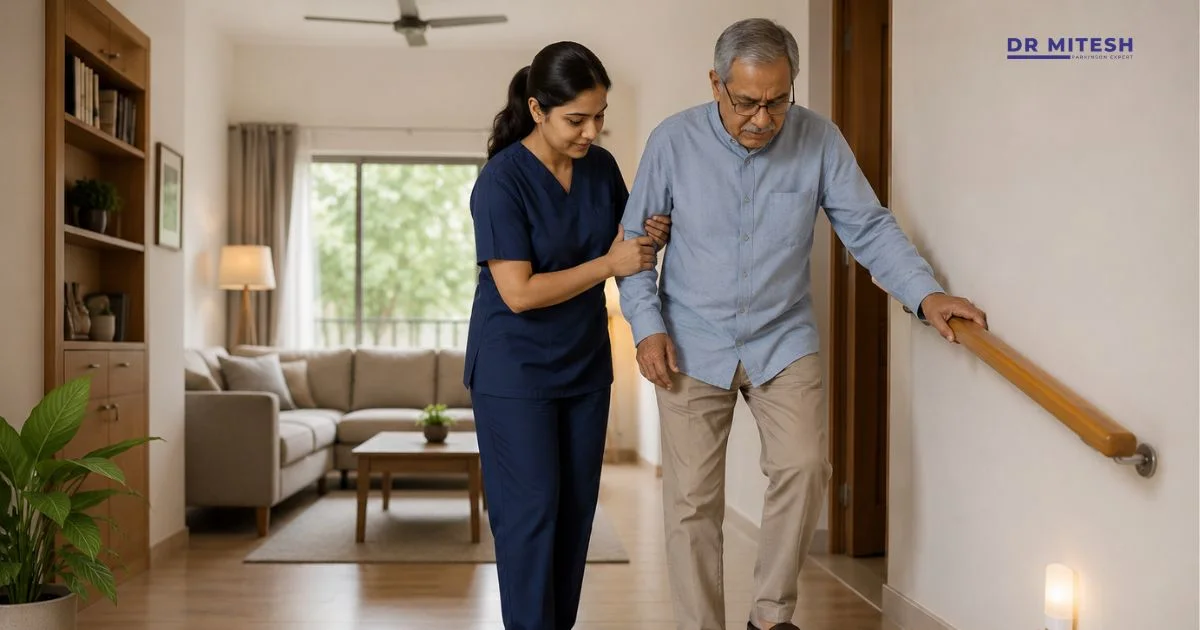
Medically reviewed by Dr. Mitesh Chandarana | Last updated: August 2026
Falls are one of the most serious and defining features of Progressive Supranuclear Palsy (PSP) not just a possible complication, but often one of the very first symptoms that brings patients to a neurologist. Unlike falls in typical Parkinson’s disease, which tend to develop later in the disease course, falls in PSP frequently appear early and follow a distinct, recognizable pattern that makes them particularly dangerous.
(For a broader look at what frequent falling can signal neurologically, see our guide on What Frequent Falling Means. This piece focuses specifically on PSP and practical home safety.)
This guide explains why PSP falls happen the way they do, and provides a practical, room-by-room approach to reducing fall risk at home.
Why PSP Falls Are Different and More Dangerous
Three features specific to PSP combine to make falls both more frequent and more severe than in other movement disorders:
1. Backward Falls
PSP characteristically causes an unstable, backward-leaning posture, leading to falls backward rather than forward – this is a hallmark feature that helps distinguish PSP from typical Parkinson’s disease early in the disease course. Backward falls are particularly dangerous because there’s often little to no protective reflex to catch oneself, and impact frequently involves the head.
2. Impaired Vertical Gaze
PSP affects the brain’s control of eye movements, particularly the ability to look downward. This means patients may not clearly see steps, curbs, low furniture, or objects on the floor directly in their path – a mechanical vision problem, not a lapse in attention.
3. Reduced Awareness of Physical Limitations
A distinctive and often underappreciated feature of PSP is that patients frequently underestimate their own fall risk and attempt movements – standing up quickly, turning suddenly without the caution their actual balance capacity requires. This isn’t stubbornness; it reflects the disease’s effect on the brain’s own self-monitoring and risk-assessment processes.
In my practice, I explain this third point carefully to families, because it’s often mistaken for the patient being careless or not listening to safety advice. Understanding that this is a neurological feature of PSP itself not a behavioural choice helps families respond with structural safety measures rather than repeated verbal reminders, which are often genuinely ineffective against this specific symptom.
A Room-by-Room Home Safety Guide
Bedroom
- Install a bed rail or grab bar for safer transfers in and out of bed
- Keep a stable, weighted walker within arm’s reach if one is prescribed
- Use a nightlight with motion sensing for night-time bathroom trips – backward falls are especially common when rising from bed or from a seated position
- Remove all rugs and runners, which are common tripping hazards
Bathroom
- Install grab bars near the toilet and inside the shower/bath
- Use a raised toilet seat with armrests to reduce the effort and postural instability involved in sitting/standing
- Use a shower chair rather than standing throughout a shower
- Apply non-slip mats both inside and outside the shower/tub
- Given PSP’s downward gaze limitation, ensure the bathroom floor is well-lit and free of any low-profile obstacles (bath mats with curled edges, low stools)
Living Areas
- Remove or secure all loose rugs and floor mats
- Rearrange furniture to create wide, clear, obstacle-free walking paths
- Avoid low coffee tables or footstools directly in walking paths, since these are difficult to see with impaired downward gaze
- Ensure adequate, even lighting throughout – avoid areas of shadow or glare near walking paths
- Consider a stable chair with armrests for easier, safer sitting and standing
Stairs
- Install handrails on both sides where possible, not just one
- Apply high-contrast, non-slip strips to the edge of each step to make them more visible
- Consider whether stairs should be avoided altogether for higher fall-risk patients, in favor of relocating a bedroom to the ground floor
General Household Measures
- Secure electrical cords and cables away from walking paths
- Use non-slip backing on any remaining mats or rugs that can’t be removed
- Keep frequently used items within easy reach to avoid unnecessary reaching, stretching, or climbing
- Ensure proper, well-fitting, closed-back footwear with good grip – avoid loose slippers or socks-only walking indoors
Assistive Devices Worth Discussing With Your Care Team
- Weighted walkers – specifically useful in PSP, as the added weight can help counteract the backward-leaning tendency, unlike a standard lightweight walker
- Fall-detection alert systems – wearable devices that can alert caregivers or emergency services if a fall occurs, particularly valuable given how quickly and unpredictably PSP falls can happen
- Physical and occupational therapy – a therapist experienced with PSP (rather than generic balance training) can assess individual risk patterns and recommend a tailored combination of exercises and equipment
(These fit into a broader care plan – see our full guide on PSP Treatment Options for how home safety planning connects with the wider multidisciplinary approach to PSP.)
Beyond the Home: General Fall Prevention Habits
- Encourage a deliberate pause before standing up, rather than rising quickly
- Avoid multitasking while walking – PSP patients are particularly vulnerable to falls when attention is divided (e.g., talking while walking, or turning to answer a question)
- Regular medication review, since certain medications affecting blood pressure or alertness can compound fall risk
- Routine vision assessment with a neuro-ophthalmologist to understand the specific gaze limitations and how to compensate for them
Supporting Someone With PSP Without Being Overprotective
Balancing safety with dignity and independence is a real challenge for families. Structural safety changes grab bars, clear pathways, proper lighting – tend to work better than constant verbal caution, both because they don’t rely on the patient overriding their own reduced self-awareness, and because they preserve a greater sense of independence and dignity in daily life.
If you’re caring for someone with PSP and falls are becoming more frequent, a home safety assessment sometimes available through occupational therapy services combined with the mechanical safety measures above, can meaningfully reduce risk while supporting continued independence for as long as possible and consulting best neurologist in ahmedabad as well.