Parkinson’s disease is a long-term neurological condition that affects movement, balance, and daily activities. Many patients and families ask one important question when symptoms start interfering with normal life: Is there a cure for Parkinson’s?
Deep Brain Stimulation (DBS) is often discussed as a powerful treatment option, especially when medicines stop working well. But does it actually cure the disease? This blog explains the reality in simple, patient-friendly language, so you can make an informed decision without confusion or false hope.
Understanding Parkinson’s Disease in Simple Terms
Parkinson’s disease happens because certain brain cells that produce dopamine slowly stop working.
Dopamine helps control:
- Smooth movements
- Muscle coordination
- Balance
- Speed of motion
When dopamine levels fall, people may experience:
- Tremor (shaking)
- Slowness of movement
- Muscle stiffness
- Balance problems
Parkinson’s is a progressive condition, which means symptoms usually change over time.
Is There a Cure for Parkinson’s Today?
At present, there is no permanent cure for Parkinson’s. Treatments are designed to:
- Control symptoms
- Improve daily functioning
- Maintain independence
- Improve quality of life
This is where advanced treatments like DBS come into the picture.
What Is Deep Brain Stimulation (DBS)?
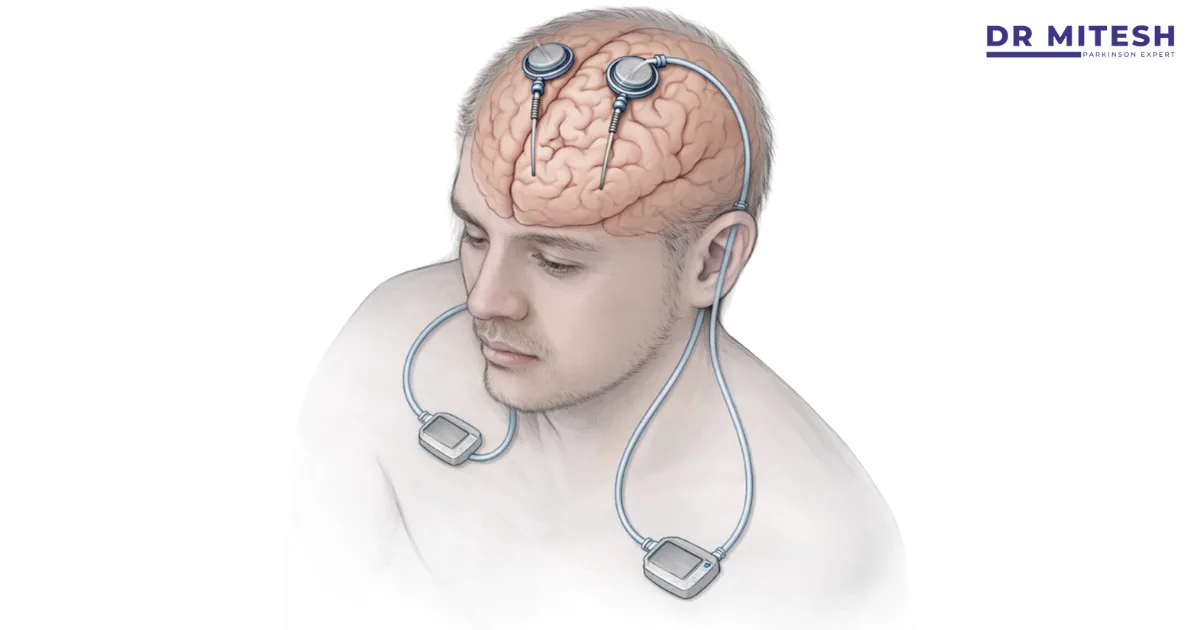
Deep Brain Stimulation is a surgical treatment used in selected Parkinson’s patients.
In simple words:
- Thin electrodes are placed in specific areas of the brain
- These electrodes send controlled electrical signals
- A battery (like a pacemaker) is placed under the skin, usually near the chest
These signals help correct abnormal brain activity that causes Parkinson’s symptoms.
Is DBS a Cure for Parkinson’s? – The Honest Answer
No, DBS is not a cure for Parkinson’s.
However, it is one of the most effective treatments for:
- Reducing symptoms
- Improving movement
- Reducing medication-related side effects
DBS does not stop the disease process, but it can make life much easier for many patients.
How DBS Treatment for Parkinson’s Helps Patients
DBS can significantly improve daily life when medicines alone are not enough.
Key benefits include:
- Better control of tremors
- Reduced stiffness and slowness
- More stable movement throughout the day
- Reduced “on-off” fluctuations from medicines
Many patients report that they feel more confident, active, and independent after surgery.
Which Parkinson’s Symptoms Improve with DBS?
DBS works best for movement-related symptoms.
Symptoms that usually improve:
- Tremor
- Muscle rigidity
- Slowness of movement
- Medication-related involuntary movements (dyskinesia)
Symptoms that may not improve much:
- Memory problems
- Speech difficulties (in some cases)
- Balance issues in advanced stages
This is why patient selection is extremely important.
Who Is the Right Candidate for DBS Surgery?
Not every Parkinson’s patient needs or benefits from DBS.
DBS may be considered if:
- Medicines help but effects wear off quickly
- Severe tremor is not controlled by medication
- Side effects from medicines are troublesome
- Symptoms interfere with daily activities
DBS may not be ideal if:
- There is severe memory loss or dementia
- Major psychiatric illness is present
- Parkinson’s symptoms do not respond to medication at all
A detailed evaluation by a movement disorder specialist is essential.
Life After DBS Surgery: What to Expect
Life after DBS surgery is usually better but not perfect.
What improves:
- Smoother movements
- Reduced dependence on high-dose medicines
- Better control during the day
What remains important:
- Regular follow-up visits
- DBS programming adjustments
- Continued medications (often at lower doses)
- Physiotherapy and exercise
DBS is best seen as a long-term management tool, not a one-time fix.
Does DBS Stop Parkinson’s from Progressing?
No. Parkinson’s disease continues to progress slowly even after surgery.
However:
- DBS can control symptoms for many years
- Patients often enjoy better quality of life during this time
This makes DBS a symptom-controlling treatment, not a disease-stopping one.
DBS vs Medicines: A Simple Comparison
| Aspect | Medicines | DBS |
|---|---|---|
| Controls symptoms | Yes | Yes |
| Cure for Parkinson’s | No | No |
| Long-term effectiveness | May fluctuate | More stable |
| Side effects | Can increase over time | Usually fewer after adjustment |
| Reversible | Yes | Yes (DBS can be adjusted or switched off) |
Common Myths About DBS
“DBS will cure Parkinson’s completely”
❌ False. It improves symptoms but does not cure the disease.
“DBS is only for very late-stage patients”
❌ Not always. Timing is important, not just disease duration.
“After DBS, medicines are not needed”
❌ Most patients still need medicines, but usually at lower doses.
Risks and Safety of DBS Surgery
DBS is generally safe when done at experienced centers.
Possible risks include:
- Infection
- Bleeding (rare)
- Temporary speech or balance changes
- Hardware-related issues
Proper patient selection and expert surgical teams significantly reduce surgery risks.
How to Decide If DBS Is Right for You
Ask yourself:
- Are symptoms affecting daily life despite medicines?
- Do medications work but cause side effects?
- Have you discussed all options with a specialist?
A detailed discussion with an experienced neurologist is crucial before deciding.
Frequently Asked Questions (FAQs)
1. Is DBS a permanent cure for Parkinson’s?
No. DBS helps control symptoms but does not cure or stop Parkinson’s disease.
2. How long does DBS benefit last?
Benefits can last many years, especially with proper programming and follow-up.
3. Will DBS work if medicines never helped me?
DBS usually works best in patients who respond to Parkinson’s medicines.
4. Can DBS improve speech and memory?
DBS mainly improves movement symptoms. Speech and memory may not improve and sometimes need separate therapy.
5. Is DBS surgery painful or risky?
The procedure is generally safe when done by experienced teams, and pain is usually well managed.
Conclusion
So, is DBS a cure for Parkinson’s? The clear and honest answer is no. But for the right patient, Deep Brain Stimulation can be life-changing. It can reduce disabling symptoms, improve independence, and help people regain confidence in daily life.
The key lies in correct timing, proper evaluation, and expert care. Consulting Movement Disorder Specialist in Ahmedabad, who specializes in movement disorders and DBS management, ensures that patients receive personalized guidance not just about surgery, but about long-term Parkinson’s care as a whole.
With the right approach, DBS is not a cure but it can be a powerful step toward living better with Parkinson’s.
Authoritative References
- Cleveland Clinic – Deep Brain Stimulation
- Mayo Clinic – DBS Surgery Risk